Best AI Strategy Tools in 2026: 7 Platforms Compared
We compare the 7 best AI strategy tools on features, pricing and user reviews, with pros and cons for Aitraxus, Cascade, WorkBoard, ClearPoint and more.
The best AI strategy tools help you create a strategy, connect it to people and budgets, and track whether it is working. Most lists of them are written by a vendor, and this one is no exception. We build Aitraxus, so it sits first on our own list. To make that useful rather than just convenient, we show how we judged each tool, what real users say, and where a competitor is the better choice.
We checked vendor websites and read user reviews on 5 November 2026. Prices, features and ratings change often, so confirm them before you buy.
How we compared the tools
- AI that helps create the strategy, not only track it. Drafting OKRs is useful, but it assumes the hard thinking is already done.
- Coverage from first conversation to board report. The fewer tools a strategy passes through, the less gets lost.
- Links to the budget. A strategy with no connection to money stays a wish list.
- Price you can see. Smaller organisations and consultants need to judge cost without a sales call.
- What users report. We read reviews for recurring themes, and we note when they are few or old.
These criteria favour small and mid-sized organisations, NGOs and consultants, which is who we build for. A large enterprise would weigh them differently, and we say so below.
The 7 best AI strategy tools at a glance
| Tool | Main focus | AI features named by the vendor | Public pricing | User rating |
|---|---|---|---|---|
| Aitraxus | Creating and running a strategy | Strategy interview, AI board brief, meeting transcription | Free until 31 Dec 2026 | Too new to cite |
| Cascade | Strategy execution | Tapestry AI | Free for up to 2 users, paid on request | 4.9 of 5 from 26 (Capterra) |
| WorkBoard | Enterprise OKRs and execution | Portfolio Analyst, Chief of Staff and Leadership Coach agents | Not shown | 4.5 of 5 from 18 (Capterra) |
| ClearPoint Strategy | Reporting for public sector and boards | AI Strategy Suggestions, Ask Me Anything assistant | Not shown, starts at 10 users | 4.8 of 5 from 53 (Capterra) |
| Perdoo | OKRs and KPIs | Spark agent, Vince coach | Free up to 5 users, then from EUR 6.40 per user a month | 4.4 of 5 from 79 (Capterra) |
| Profit.co | OKRs plus performance | Athena AI | Custom, with a 30 day trial | 4.8 of 5 from 241 (Capterra) |
| Tability | Light OKR tracking | Tabby assistant, OKR Agent | From USD 6 per user a month billed yearly | 4.6 of 5 from 165 (G2) |
1. Aitraxus: best for building and running a strategy in one place
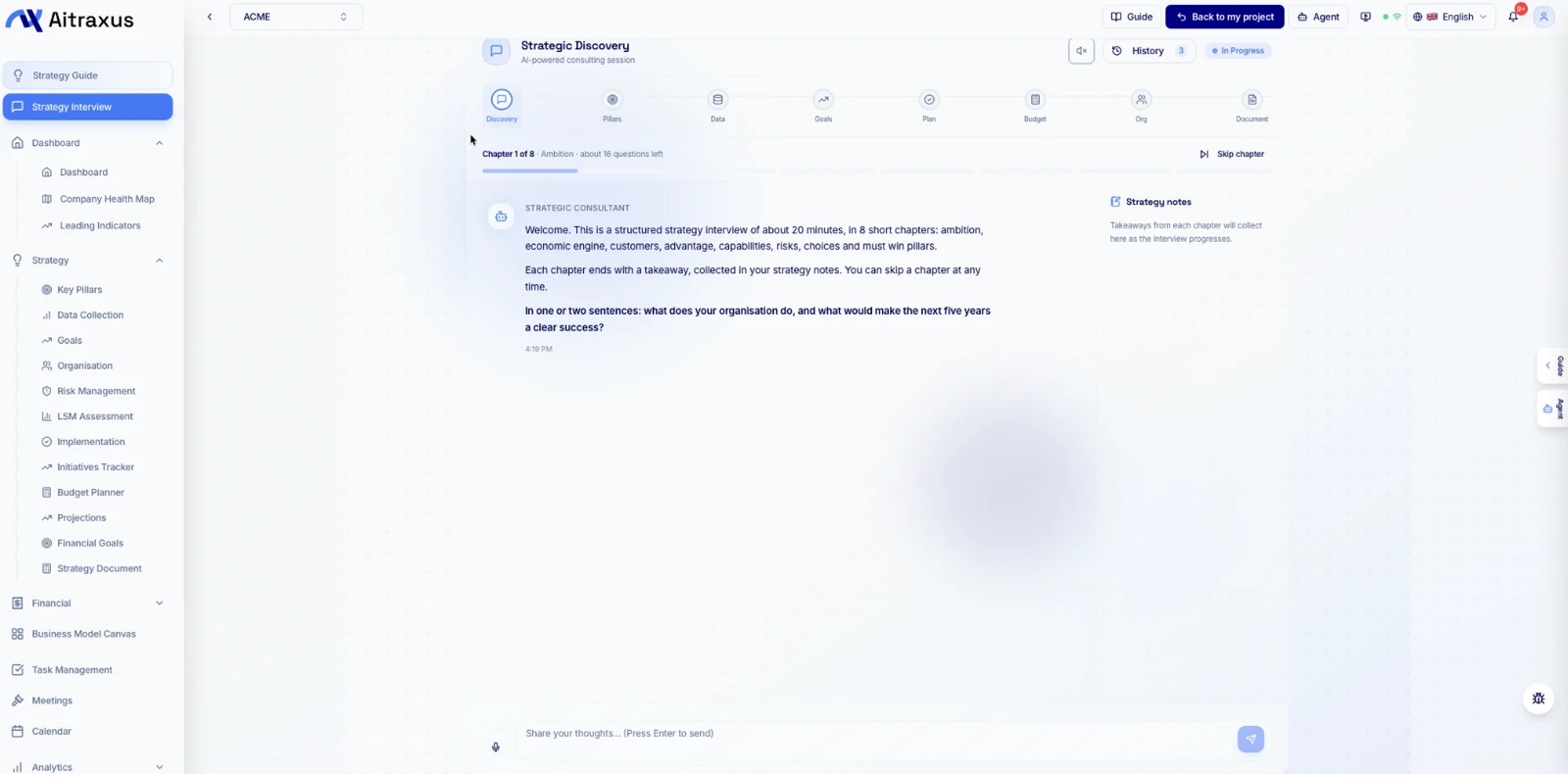
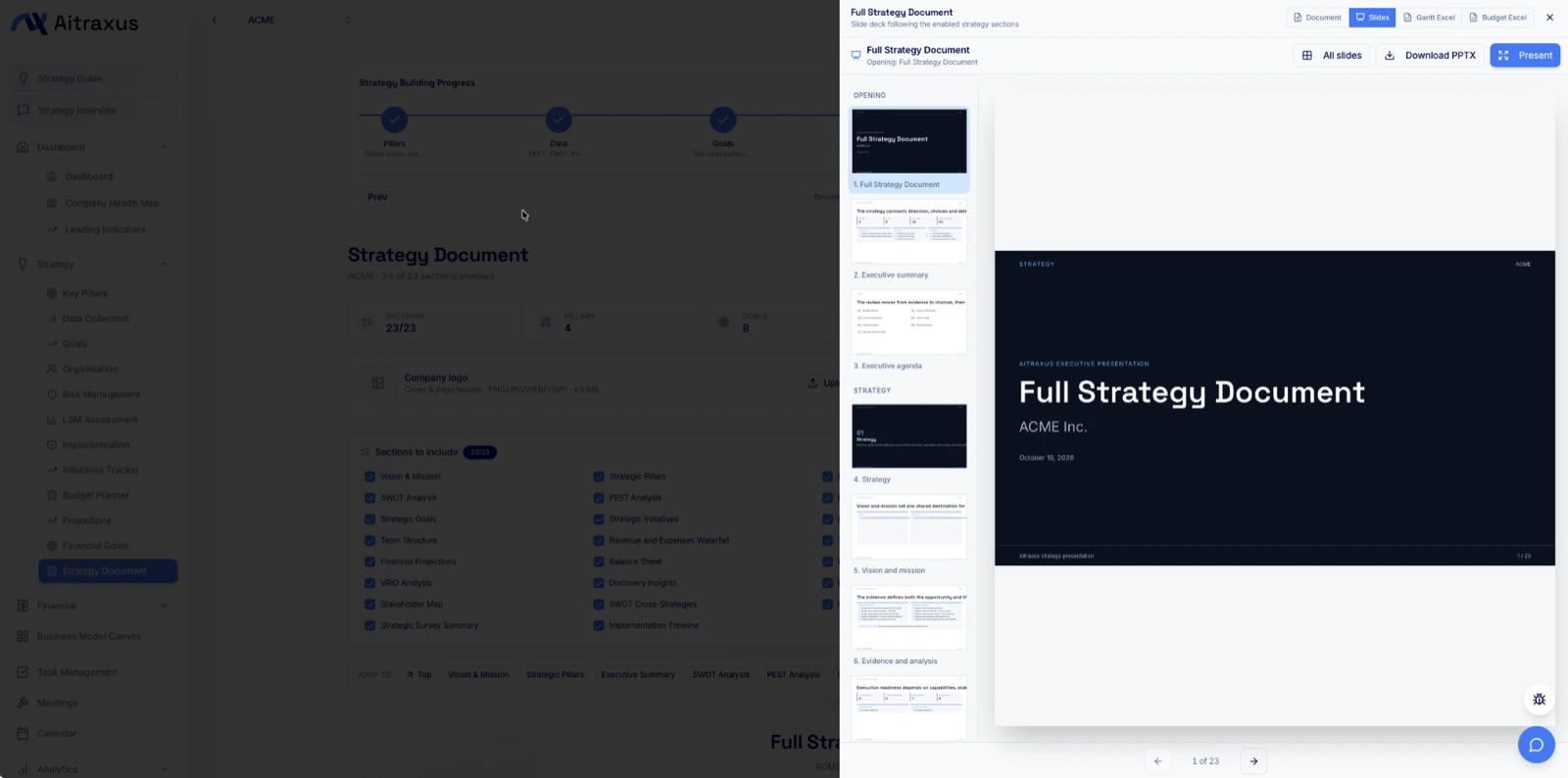
Aitraxus walks a team through eight steps: discovery, pillars, data, goals, plan, budget, organisation and the strategy document. It starts with an AI interview that turns leadership and stakeholder input into structured material, then supports frameworks such as SWOT, PEST, Five Forces, VRIO, Business Model Canvas and Balanced Scorecard.
Execution stays in the same workspace. Initiatives connect to budgets, owners, tasks and meetings. Meeting recordings can be transcribed, and AI proposes decisions, actions and minutes, which are saved only after a person accepts them. The dashboard can turn leading indicator results into a short board brief using only your recorded figures. The interface is available in 15 languages, and you can use the built-in AI or bring your own.
Pros:
- Covers the path from a blank page to a board-ready document in one place.
- Links every budget line to the goal or initiative it funds.
- Free for all users until 31 December 2026, and anyone who registers by then keeps their first project free forever.
Cons:
- It is a young product, so you will find fewer public reviews and case studies than for the established names below.
- Pricing after 2026 has not been announced.
- Large enterprises with long lists of system integrations should also look at WorkBoard or Cascade.
Best for: SMEs, NGOs and consultants who need to create a strategy, not only track one.
2. Cascade: best for multi-team execution at larger companies
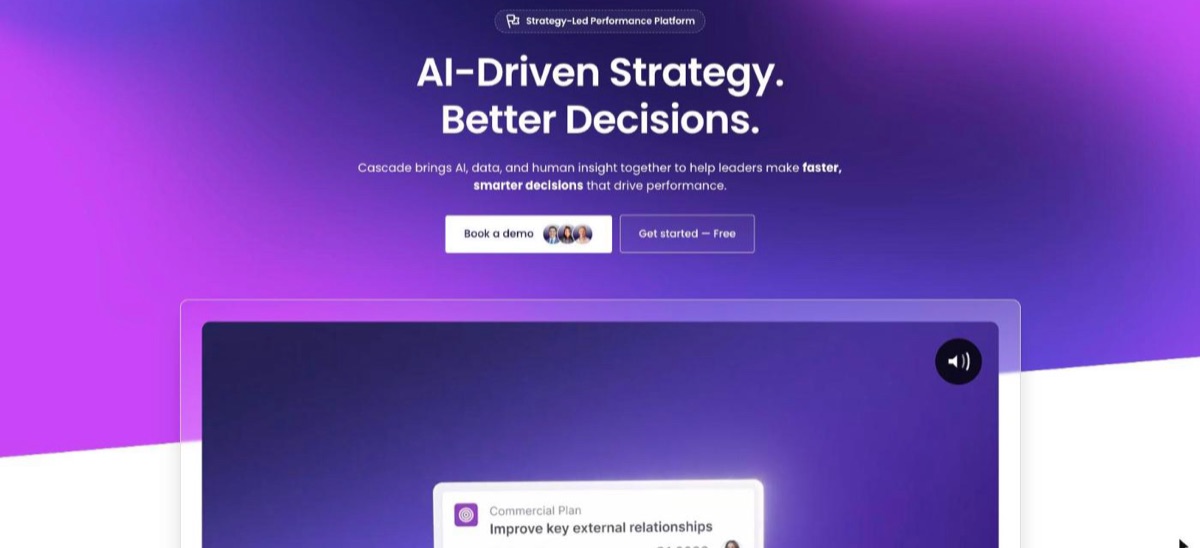
Cascade is an established strategy execution platform with an AI engine called Tapestry. Its pricing page lists AI strategic planning, alignment, updates, and dependencies and risks. There is a free plan for up to 2 users, and Essentials and Enterprise pricing is available on request.
Pros (from Capterra reviews):
- Intuitive, with real-time status on the plan.
- Reviewers describe easy setup.
- Ties initiatives to KPIs, according to one reviewer.
Cons (from Capterra reviews):
- Can be too complex for simple initiative tracking.
- Reviewers mention limits in printed reports and graph formatting.
- Reviews from 2017 and 2018 mention English only, so check current language support.
The newest review on the first page we read dates from 2021, so treat these as older signals.
Best for: mid-market and enterprise teams running strategy across many teams.
3. WorkBoard: best for enterprise OKRs at scale
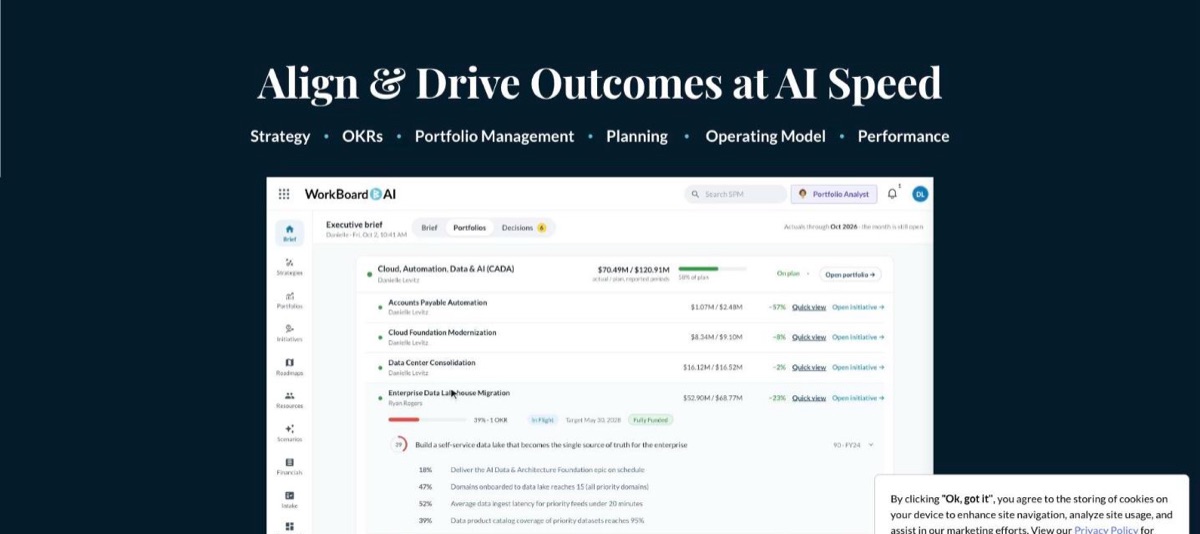
WorkBoard describes itself as an AI native platform connecting strategy to execution, and names Portfolio Analyst, Chief of Staff and Leadership Coach agents. It acquired the OKR platform Quantive in May 2025. Prices are not published.
Pros (from Capterra reviews):
- A strong tool for running OKRs.
- Links meetings to OKRs, according to one reviewer.
- Mobile tracking of OKRs, according to one reviewer.
Cons (from Capterra reviews):
- Several reviewers find it hard to learn.
- Some describe the interface as clunky or slow.
- Some report limited or difficult integrations.
Only one of the reviews we read is from 2022 or later, so recent versions may differ.
Best for: large enterprises with a mature OKR program.
4. ClearPoint Strategy: best for public sector and regulated reporting
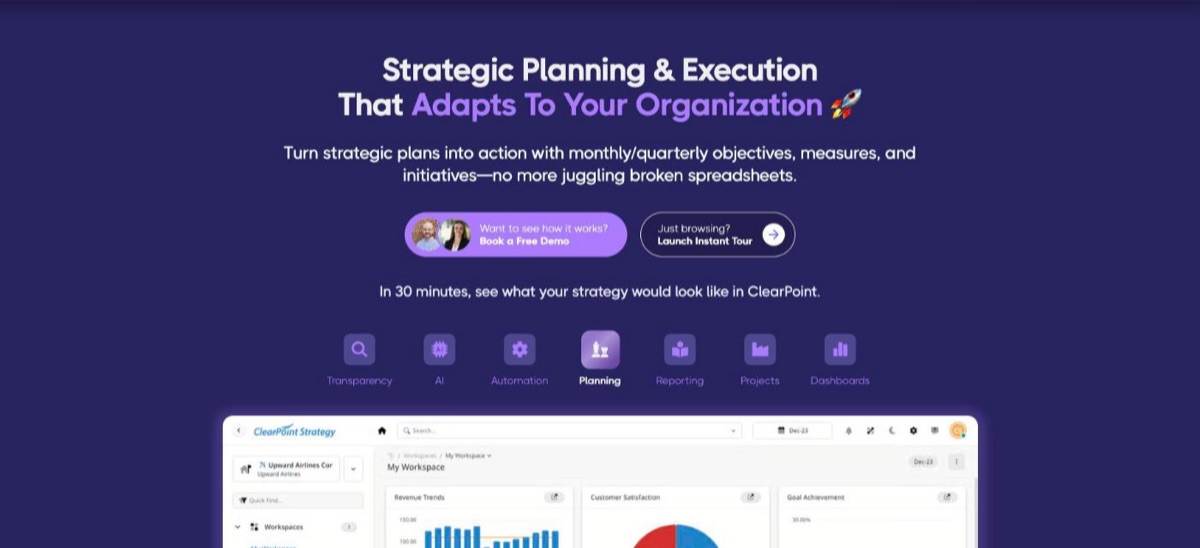
ClearPoint focuses on organisations that report to a board, council or regulator, highlighting local government, healthcare and financial services. It names AI Strategy Suggestions and an Ask Me Anything assistant, and states that it is SOC 2 Type II audited. Plans start at 10 users, and you get a price on a call.
Pros (from Capterra reviews):
- Customer service stands out, scoring 4.9 of 5.
- Reviewers call it easy to use.
- Gives teams a common structure and language for planning.
Cons (from Capterra reviews):
- Setup takes time, with a learning curve.
- Report and graph customisation is limited, according to several reviewers.
- Bulk administration is missing, according to one reviewer.
Best for: public bodies and organisations with formal reporting duties.
5. Perdoo: best low cost option for OKR programs
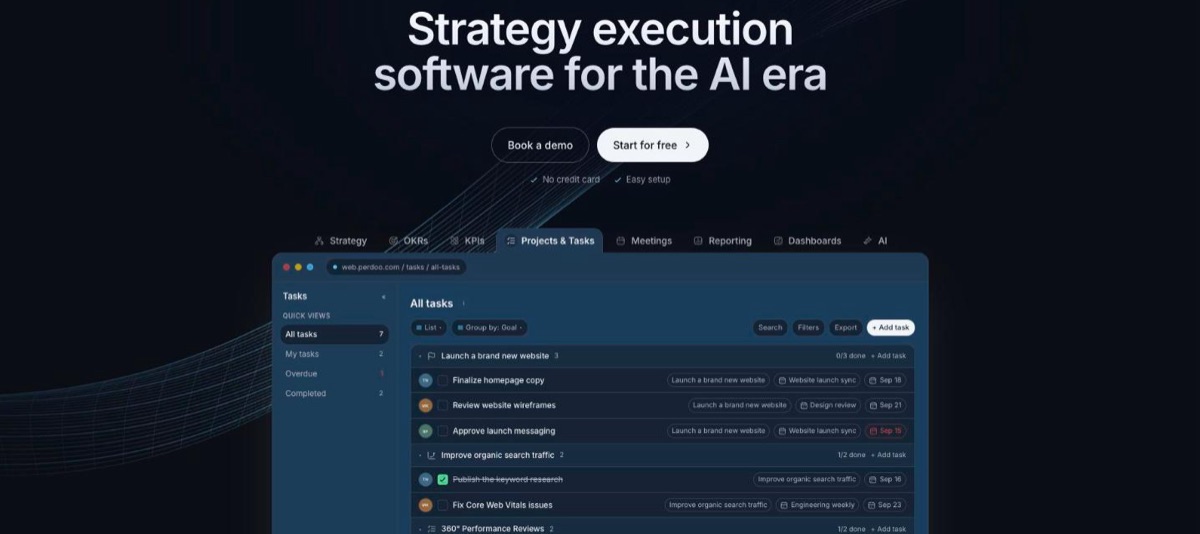
Perdoo has one of the clearest price lists here: free for up to 5 users, Premium at EUR 6.40 and Supreme at EUR 8 per user a month. Premium adds the Spark agent, the Vince coach and an MCP server. The free plan includes OKRs, KPIs, projects, strategy maps and meetings. Perdoo lists Fjällräven, Intercom and REWE among its customers.
Pros (from Capterra reviews):
- Makes OKRs easy to structure and see across teams.
- Clean, easy interface.
- Support is rated well, at 4.5 of 5.
Cons (from Capterra reviews):
- The mobile app is weaker than the web version.
- Report and dashboard customisation is limited.
- One Key Result cannot easily align to several Objectives, according to one reviewer.
Best for: teams that already have a strategy and want affordable OKR discipline.
6. Profit.co: best for combining OKRs with performance management
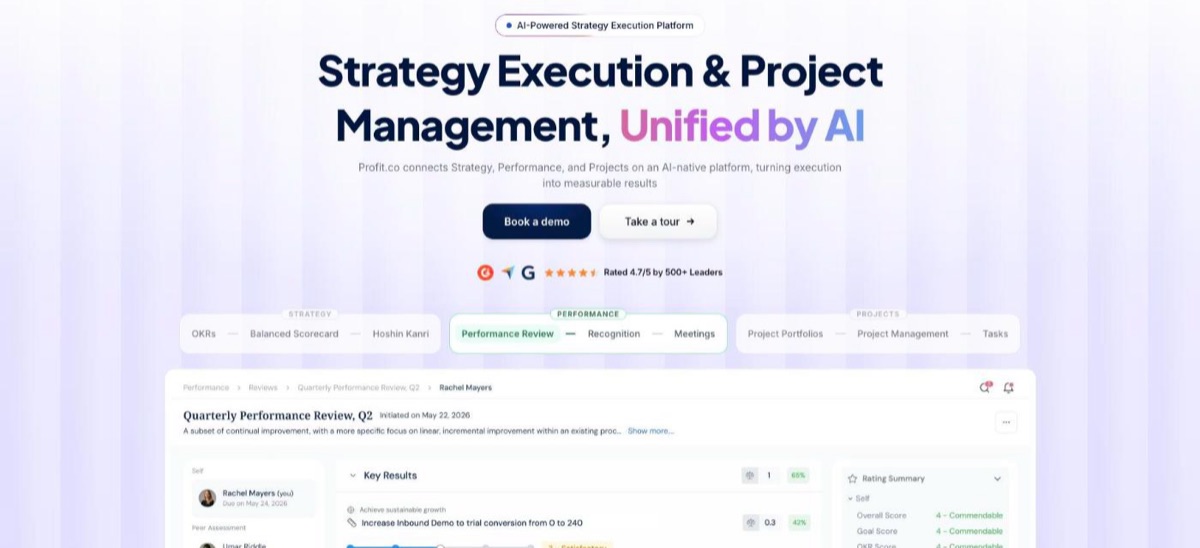
Profit.co pairs strategy with performance, projects and engagement modules. Its Athena AI runs on credits and covers OKR drafting, strategy questions, review summaries, project scoping and meeting transcription. Pricing is custom, and a 30 day trial includes 250 AI credits.
Pros (from Capterra reviews):
- Responsive support, rated 4.9 of 5.
- Dashboards and reporting are praised.
- Includes many prebuilt KPIs, according to one reviewer.
Cons (from Capterra reviews):
- Slow to learn and set up.
- The range of options needs training.
- Limited integrations, according to one reviewer.
Several recent five-star reviews come from one organisation, so read the rating with that in mind.
Best for: organisations that want OKRs, reviews and projects in one suite.
7. Tability: best for small teams that want light OKR tracking
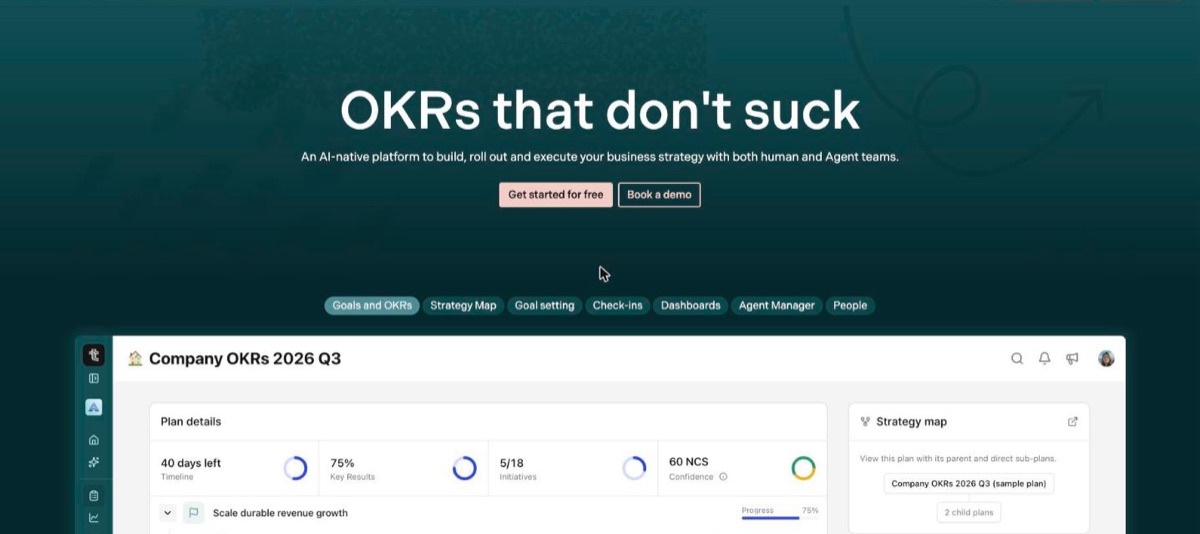
Tability keeps things simple. Basic costs USD 6 and Premium USD 10 per user a month billed yearly, with a 14 day trial. It offers AI assisted goal setting and, on Premium, the Tabby assistant and AI retrospectives. Its customers page lists OLX and Merck.
Pros (from G2):
- Ease of use and an intuitive interface are the most common tags.
- Progress tracking comes up often.
- AI mode gives quick help, according to one reviewer.
Cons (from G2):
- Some first-time users find it complicated.
- Navigation can feel too complicated, according to one reviewer.
- Advanced reporting has limits, according to one reviewer.
Best for: small teams that know their goals and want a steady check-in habit.
What about ChatGPT, Claude and Gemini?
General AI assistants are excellent thinking partners for research and first drafts. They do not keep your goals, budgets, owners and progress in a structured record that a team can update every month. We cover the differences in Aitraxus vs ChatGPT, Claude and Gemini.
How to choose an AI strategy tool
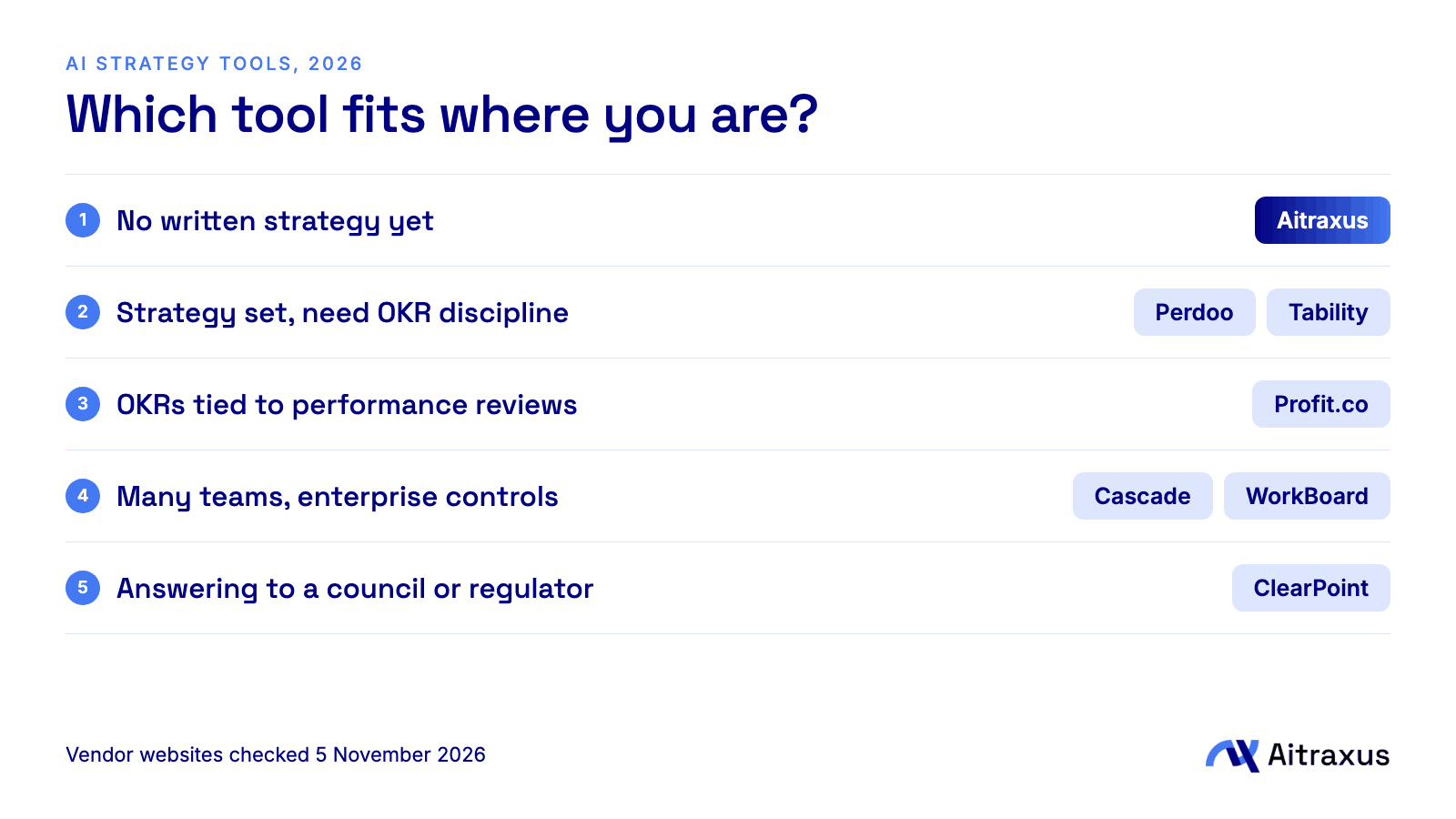
- You have no written strategy yet: choose a tool that helps you create one, such as Aitraxus.
- You have a strategy and need OKR discipline: compare Perdoo and Tability.
- You want OKRs tied to performance reviews: look at Profit.co.
- You run many teams and need enterprise controls: compare Cascade and WorkBoard.
- You answer to a council or regulator: start with ClearPoint.
- You report to a board every quarter: read our board reporting software guide too.
Before you sign, ask each vendor four questions. What does the AI do with our data? Is the AI included in the plan we are buying? What is the full price including setup? How does our data leave if we move on?
Sources
- Cascade pricing and Capterra reviews
- WorkBoard pricing, Capterra reviews and Quantive acquisition release
- ClearPoint pricing and Capterra reviews
- Perdoo pricing, company page and Capterra reviews
- Profit.co pricing and Capterra reviews
- Tability pricing, customers and G2 reviews
Frequently asked questions
What is an AI strategy tool?
It is software that uses AI to help an organisation create a strategy, turn it into goals and initiatives, and track progress. Some tools focus on creating the strategy, while others focus on tracking execution.
What is the best AI tool for strategic planning?
It depends on your starting point. We think Aitraxus is the best fit for organisations creating a strategy from scratch, while Cascade and WorkBoard suit large multi-team rollouts, and ClearPoint suits formal public reporting.
Can AI write a strategic plan?
AI can draft structure, surface gaps and summarise input quickly. Your leadership team still has to make the choices and own the result, because a plan nobody decided on will not be carried out.
Is there a free AI strategy tool?
Yes. Aitraxus is free until 31 December 2026, Perdoo has a free plan for up to 5 users, and Cascade has one for up to 2 users. Check each vendor's limits before you commit.
Can I use ChatGPT for strategic planning instead?
You can use it for research and first drafts. It will not hold a live record of goals, budgets and owners for your team, so most organisations pair an assistant with a dedicated tool.
Try Aitraxus free and open the ACME demo project to see a filled strategy.