How to Present Strategy to the Board: Paper, Slides and Examples
How to present strategy to the board: structure the board paper, label the ask, order your slides and avoid the mistakes that derail decisions.
To present strategy to a board, send a short paper about a week before the meeting, state up front exactly what you want the board to decide, show the options you considered and the risks, and use the meeting for discussion rather than for reading slides aloud. The board's job is to challenge and approve the direction and then monitor it, not to run it.
This guide covers what boards look for, how to structure a board paper and a strategy presentation, a simple slide order, a worked example and the mistakes that most often derail board discussions.
What boards look for in a strategy presentation
A board needs enough to judge whether the strategy is sound, not every operational detail. A 2008 note from law firm King & Spalding, published on the Harvard Law School Forum on Corporate Governance, says directors need the assumptions behind the strategy, the alternatives that were considered and the risks involved, and that discussion works best at a middle level of detail.
Three questions sit behind most board challenges:
- Are the assumptions realistic?
- Why this option and not the others?
- What could go wrong, and how will we know early?
The National Association of Corporate Directors reported in April 2026 that its Governance Outlook survey ranks oversight of strategy execution as a top area for board improvement. It also notes that boards and management often lack a shared view of where strategy development ends and execution begins. A good presentation makes that line clear.
Board paper vs board presentation
The paper carries the content. The presentation, if there is one, should be short and focus on the decision.
| Board paper | Board presentation | |
|---|---|---|
| Purpose | Gives directors everything they need to decide | Focuses the discussion on the key questions |
| When | Sent before the meeting | Given in the meeting |
| Length | Short, with appendices for detail | A few slides at most |
| Best practice | Read in advance | Take the paper as read and present only the ask |
The Governance Institute of Australia's guidance on board papers calls them the primary means by which directors get the information they need for decisions and oversight. It notes that circulating papers approximately one week before a meeting is common practice.
Label every item: decision, discussion or noting
Directors should know at a glance what each paper asks of them. Both the Governance Institute of Australia and the UK's Good Governance Institute recommend making the ask explicit.
| Paper type | What the board does | Example ask |
|---|---|---|
| For decision | Approves or rejects a proposal | Approve the three-year strategy and budget |
| For discussion | Gives views that shape a later decision | Discuss two options for entering a new market |
| For noting or assurance | Takes note, asks questions if needed | Note progress on strategic initiatives this quarter |
When you ask for a decision, give the exact wording of the proposed resolution, as the Governance Institute of Australia recommends.
How to structure a board strategy paper
Put the purpose and the recommendation at the very front. The Good Governance Institute suggests a cover sheet that states what is asked of directors, followed by the problem, why it matters now, three or four options including taking no action, the evidence, and the recommendation. It puts the right length at about three to four pages of text, or 2,000 words.
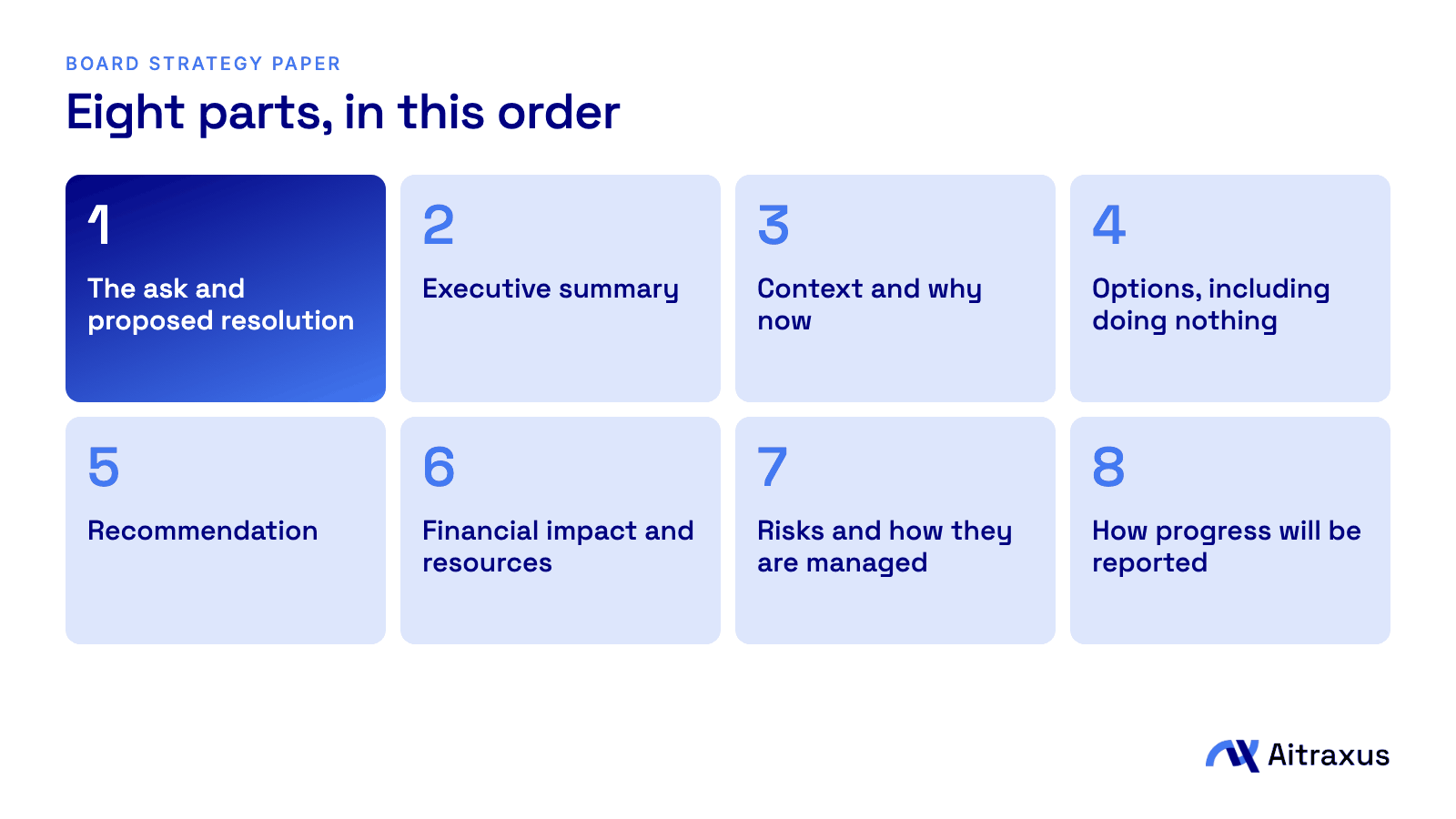
- The ask: decision, discussion or noting, and the proposed resolution.
- Executive summary in a few sentences.
- Context: where we are and why this matters now.
- Options considered, including doing nothing.
- Recommendation and why.
- Financial impact and resources.
- Risks and how they will be managed.
- How progress will be measured and reported.
A simple slide order for the meeting
If the chair wants a presentation, keep it to the decision. Ask the chair in advance whether the board will take the paper as read.
- The decision we are asking for.
- What has changed since the last meeting.
- The options and our recommendation.
- The numbers: cost, return and timing.
- Key risks and early warning signs.
- What happens next and when the board will hear back.
Worked example: an NGO asks to open a second office
This example is fictional, for illustration.
| Part | Content |
|---|---|
| The ask | For decision: approve opening a regional office in the north |
| Context | Demand for the youth program in the north has doubled, and travel costs are rising |
| Options | Do nothing; run the program remotely; open a small office |
| Recommendation | Open a small office with two staff, reviewed after 12 months |
| Finance | Set-up cost and annual running cost, partly covered by a confirmed grant |
| Risks | Grant not renewed, hiring delays, weaker oversight from head office |
| Measures | Participants reached, cost per participant, placements after 12 months |
| Proposed resolution | The board approves opening the northern office within the approved budget, with a review at the meeting 12 months after opening |
Presenting bad news to the board
Say it early and plainly, before the board hears it elsewhere. Explain what happened, what it means for the strategy, what you have already done and what you need from the board. A board that is surprised loses trust faster than a board that is told about a problem with a plan to fix it.
The board's role vs management's role
| Board | Management | |
|---|---|---|
| Strategy | Challenges, approves and monitors | Develops and proposes |
| Execution | Oversees progress and risks | Delivers and reports |
| Resources | Approves the budget | Allocates and manages it |
| Performance | Holds management to account | Measures and improves results |
As Jay D. Miller is quoted in the NACD release, "the board's role cannot drift to execution". A good strategy paper helps the board stay at the right level.
After the meeting
Record the decision and the actions in the minutes, with owners and dates. Send a short follow-up to the people who will deliver the work. At the next meeting, open with progress on what the board approved.
Common mistakes
- A paper written for management rather than for the board.
- No clear ask, so directors do not know what they are deciding.
- No proposed resolution for a decision item.
- Options that are not real options, only the recommendation and a straw man.
- A pack sent too late to read properly.
- Reading slides aloud instead of discussing the questions.
- No plan for how the board will track progress.
Prepare board meetings and strategy packs in Aitraxus
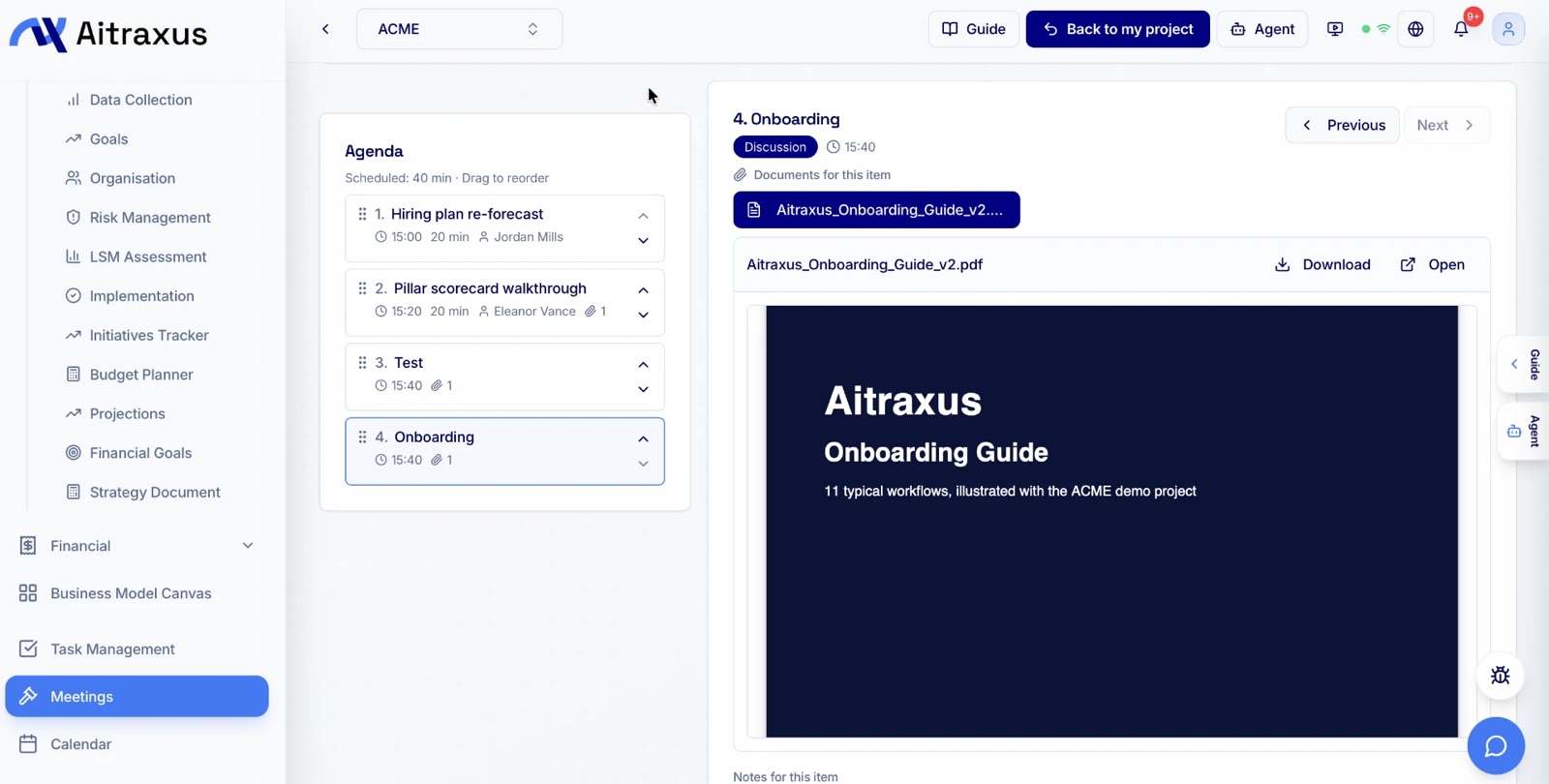
In Aitraxus Meetings you build the agenda, attach documents to each item, record minutes, decisions and action items, and generate a board pack with charts that you can download as a PDF.
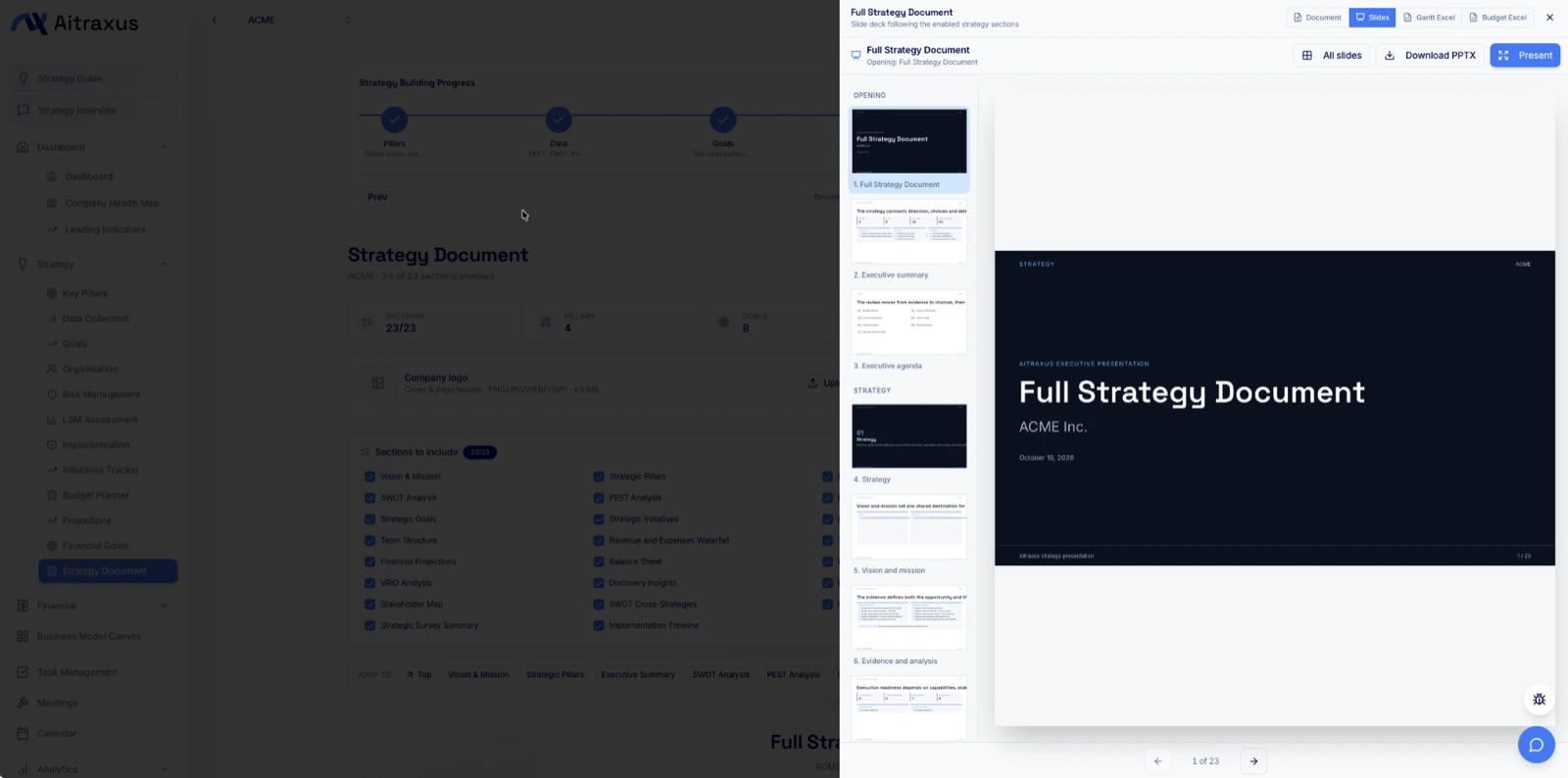
The Strategy Document produces a board-ready report and an executive slide deck from your live data, which you can present full screen or download as PowerPoint.
For more, read our board reporting software guide and the strategic planning process.
Sources
- Governance Institute of Australia, Board papers guidance, 2021
- Good Governance Institute, Writing board papers
- King & Spalding, "The Board's Role in Corporate Strategy", Harvard Law School Forum, 2008
- NACD, "Boards' New Playbook for Oversight of Strategy Execution", 2026
Frequently asked questions
How do you present strategy to a board?
Send a short paper in advance, state the decision you want at the front, show the options and risks, and use the meeting to discuss the key questions rather than to read slides.
How many slides should a board presentation have?
As few as possible. Six slides that cover the ask, the context, the options, the numbers, the risks and the next steps are usually enough when the paper has been read.
What is the difference between a board paper and a board presentation?
The paper gives directors all the information they need and is read before the meeting. The presentation is short and focuses the discussion on the decision.
How far in advance should board papers be sent?
About a week before the meeting is common practice, according to the Governance Institute of Australia. Check your own board's rules.
What does "for noting" mean in a board paper?
It means the board is being informed and is not asked to decide. Directors can still ask questions or raise concerns.
What is the board's role in strategy?
The board challenges, approves and monitors the strategy, and holds management to account for delivering it. Management develops the strategy and runs the business.
Try Aitraxus free and open the ACME demo project to see board-ready meetings and reports.