What Is a Budget Line Item? Definition, Examples and Sample Budget
A budget line item is one row of income or cost in a budget. See the 5 categories, a full sample budget and how to read variances.
A budget line item is a single row in a budget that records one specific source of income or type of cost, with its planned amount. Rent is a line item. So is a monthly software subscription, a loan interest payment or revenue from one product. Added together, the lines make up the budget.
The International Monetary Fund's budgeting glossary treats the line item as the unit at which money is approved: an appropriation is the approved budget for a line item. That is why line items matter. They are the level at which someone can be asked what the money was for and what happened to it.
This guide covers the five categories every line belongs to, a full sample budget, how a line item budget compares with other formats, and how to read the variances once actual numbers come in.
What a budget line item contains
A useful line has more than a name and a number. Each row should answer five questions.
| Field | Question it answers | Example |
|---|---|---|
| Name | What exactly is this? | Paid search advertising |
| Category | Which of the five buckets? | Operating expenses |
| Owner | Who answers for it? | Head of Marketing |
| Budget and actual | What did we plan and what happened? | EUR 1,250 plan, EUR 1,400 actual |
| Behaviour | Fixed or variable? Recurring or one-off? | Variable, recurring |
A line with no owner is a number nobody will defend. A line called "misc" is a number nobody can explain. Both are worth fixing before you add more detail.
The 5 categories of budget line items
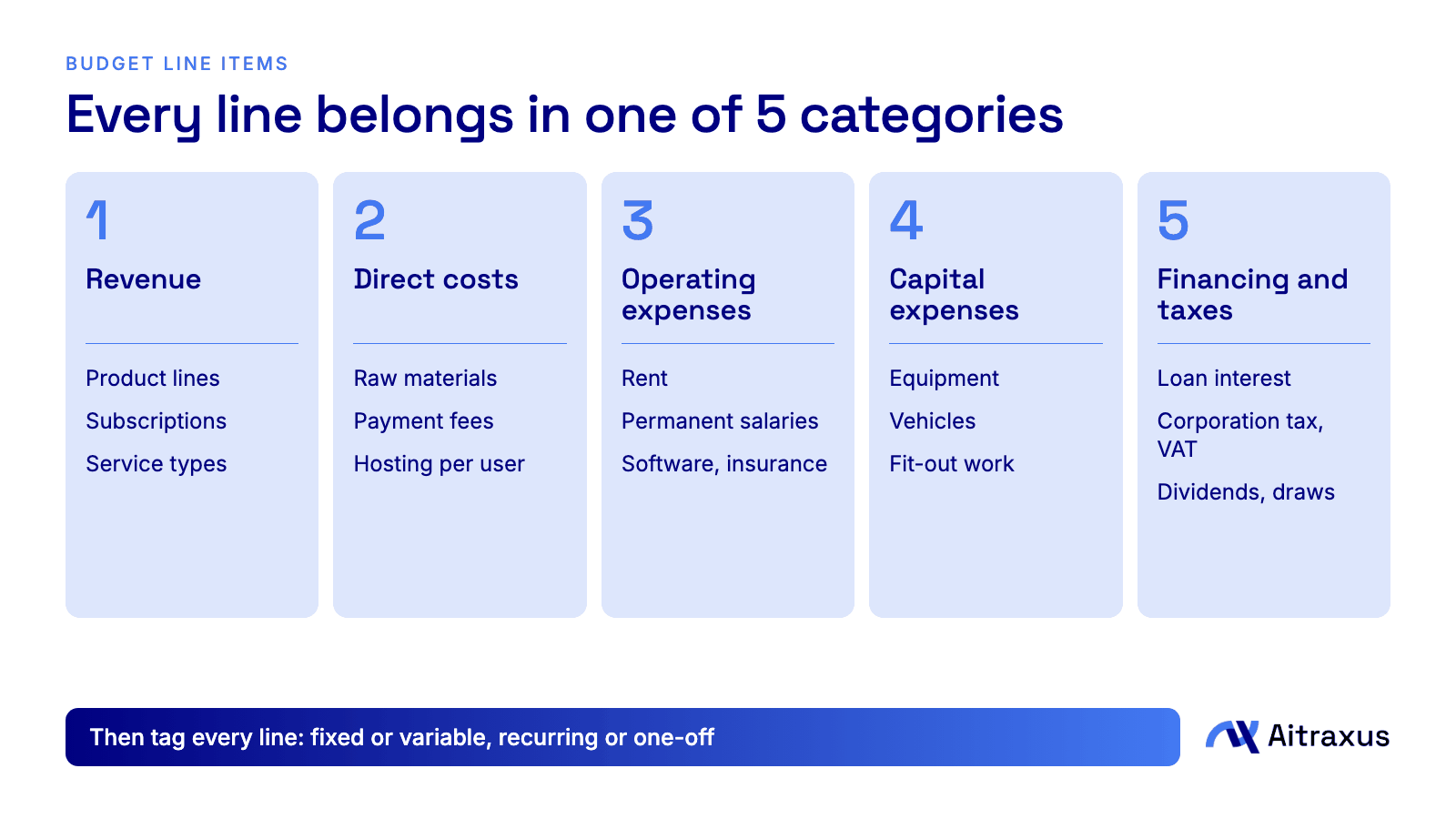
Every amount flowing into or out of a business belongs in exactly one of five categories.
1. Revenue
Money earned from selling products or services. Split it by stream, such as product line, subscription tier or service type, and mark each stream as recurring or one-off. A one-off consulting job and a monthly subscription both count as revenue, but only one is predictable.
2. Direct costs
Costs that rise with each unit sold, also called cost of goods sold: raw materials, payment processing fees, hosting per user, contractor time on a specific job. A simple test is to ask whether the cost would disappear if you sold nothing this month. If it would, it is a direct cost.
3. Operating expenses
The cost of running the business whatever the sales volume: rent, permanent salaries, software, insurance, accounting. Group these by function, such as sales and marketing, product, and administration, so you can see what each part of the business costs.
4. Capital expenses
Purchases of assets you will use for more than one period: equipment, vehicles, major fit-out work. International accounting standard IAS 16 covers items like these and includes directly attributable costs in their cost. In the profit and loss view their cost is normally spread across their useful life as depreciation.
5. Financing and taxes
Loan interest and repayments, corporation tax, VAT, dividends and owner draws. Keep principal repayments apart from interest. Repaying principal moves cash but is not an expense, so only the interest belongs in profit and loss.
A sample line item budget
Here is a complete annual budget for a fictional software company. The numbers are illustrative.
| Line item | Category | Annual budget (EUR) | Behaviour |
|---|---|---|---|
| Subscriptions | Revenue | 240,000 | Variable, recurring |
| Implementation services | Revenue | 60,000 | Variable, one-off |
| Hosting per user | Direct costs | 18,000 | Variable, recurring |
| Payment processing fees | Direct costs | 6,000 | Variable, recurring |
| Delivery contractors | Direct costs | 30,000 | Variable, one-off |
| Permanent salaries | Operating expenses | 120,000 | Fixed, recurring |
| Office rent | Operating expenses | 24,000 | Fixed, recurring |
| Software subscriptions | Operating expenses | 9,000 | Fixed, recurring |
| Paid advertising | Operating expenses | 15,000 | Variable, recurring |
| Insurance and accounting | Operating expenses | 6,000 | Fixed, recurring |
| Laptop depreciation | Capital expenses | 4,000 | Fixed, recurring |
| Loan interest | Financing and taxes | 3,000 | Fixed, recurring |
Revenue of EUR 300,000 less EUR 54,000 in direct costs, EUR 174,000 in operating expenses and EUR 4,000 in depreciation gives an operating profit of EUR 68,000. After EUR 3,000 of interest, profit before tax is EUR 65,000.
The laptops show why one purchase can need two views. A EUR 12,000 fleet used for three years costs EUR 12,000 of cash in the year you buy it, but only EUR 4,000 a year in profit and loss. Treat it as a single month's expense and that month looks terrible while the next 35 look better than they are. Your accountant can confirm the treatment under your local rules.
Line item budget vs program and performance budgets
"Line item budget" also names a budget format. It organises spending by what is bought. Other formats organise the same money by purpose or by results.
| Format | Organised by | Question it answers | Main weakness |
|---|---|---|---|
| Line item | Inputs, such as salaries or rent | What are we spending on? | Does not show why |
| Program | Activities or programs | What does each program cost? | Needs costs to be allocated |
| Performance | Results and activity levels | What did the money achieve? | Needs reliable measures |
The Government Finance Officers Association describes line items as categories of inputs that give easy accountability but do not support strategic decisions on their own. These formats also combine well. You can keep line items for spending control and link each one to the program or initiative it funds.
Advantages and disadvantages of a line item budget
Advantages:
- It is simple to build, read and explain.
- Spending control is clear, because every amount has a named place.
- Comparing with last year and spotting unusual movements is easy.
Disadvantages:
- It shows what was bought, not what it achieved.
- It invites adding a percentage to last year's numbers rather than asking whether a cost is still needed.
- Detail can hide the big picture, especially with many small lines.
- Fixed line limits can discourage sensible moves between lines.
How to create a line item budget in 6 steps
- Collect last year's actuals from your accounting records, so that you start from evidence.
- Map every account to one of the five categories, and make sure the lines match your chart of accounts so actuals can flow in cleanly.
- Split vague lines. "Marketing" becomes paid ads, content, events and tools.
- Tag each line as fixed or variable and as recurring or one-off.
- Set amounts from drivers rather than guesses: for example, users multiplied by hosting cost per user.
- Name an owner for each line and agree how often you will compare budget with actual.
How to read budget vs actual
A variance is the difference between the budget and the actual amount. The headline number can mislead, because it mixes changes in volume with changes in price.
A flexible budget separates the two by adjusting the plan for the volume you really achieved. Here is an illustrative example.
| Payment fees | Amount (EUR) |
|---|---|
| Original budget, on EUR 100,000 revenue (2%) | 2,000 |
| Actual, on EUR 120,000 revenue | 2,300 |
| Static variance | 300 over budget |
| Flexed budget, 2% of EUR 120,000 | 2,400 |
| Flexed variance | 100 under budget |
The line looks overspent, yet costs per euro of revenue actually fell. A favourable variance also deserves a question. Money under budget can mean a real saving, or a project that has quietly slipped.
Set a materiality rule so that reviews stay focused, such as explaining any line that moves by more than a set percentage or amount. Choose a threshold that suits your size.
Line items in NGO and grant budgets
Grant funded organisations often report by line item, and funders may set rules for moving money between lines. The IMF glossary calls this kind of transfer virement. Before you move funds, check the limits in your grant agreement, and record who approved each change. A second view that groups the same lines by program helps you show funders what each activity cost.
Common mistakes
- Lines with no owner.
- A "misc" line that keeps growing.
- Owner pay hidden in operating expenses, or left out, which makes the business look more profitable than it is.
- Loan repayments mixed with expenses.
- Big purchases recorded as one month's cost, with no depreciation.
- Only explaining overspends and ignoring underspends.
- Lines that do not map to the chart of accounts, so that actuals need manual sorting.
How to manage budget line items in Aitraxus
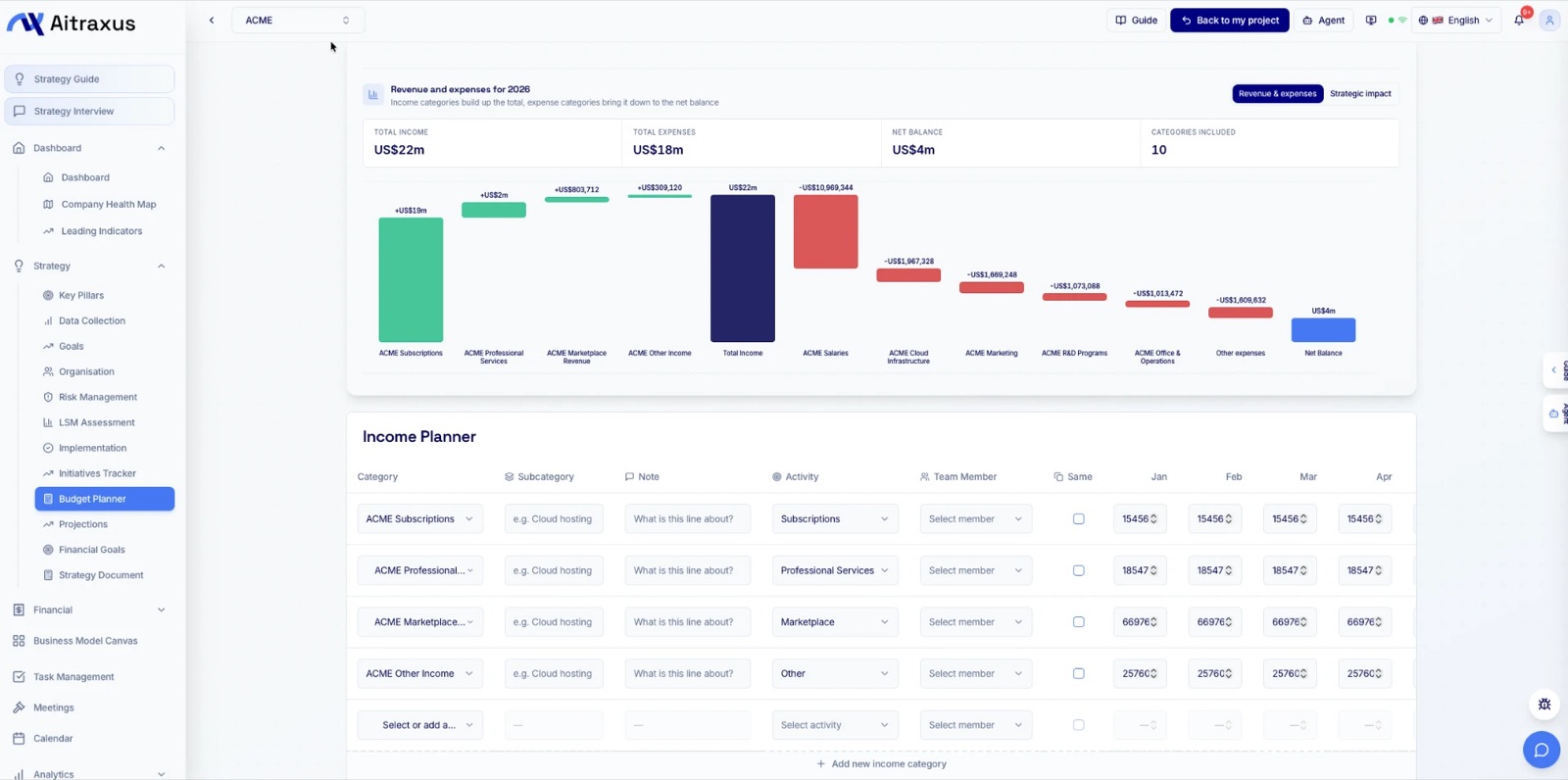
Spreadsheets show what you plan to spend. They rarely show why. In the Aitraxus Budget Planner you add income and expense lines per category and month, link each line to the goal, initiative or indicator it funds, and name a budget owner. Linked amounts and owners then appear in the Gantt chart and Initiative Tracker, so strategy and money stay connected.
To go further, read how to link financial planning to strategic objectives and conservative vs optimistic budgets.
Sources
- IMF budget glossary: appropriation and virement
- IAS 16 Property, Plant and Equipment, IFRS Foundation
- GFOA guide to designing a local government budget
- Flexible budget variance, open managerial accounting text
Frequently asked questions
What is a line item in a budget?
It is one row in a budget for a specific type of income or cost, such as rent or subscription revenue, with its planned amount. Line items add up to the total budget.
What is an example of a line item budget?
A list of rows such as salaries, rent, software, advertising and loan interest, each with a budgeted amount and usually an actual amount beside it. The sample table above shows a complete one.
What is the difference between a line item budget and a program budget?
A line item budget groups money by what is bought, such as salaries or rent. A program budget groups the same money by the activity it pays for, which makes the cost of each activity visible.
Is depreciation a budget line item?
It can be. Many profit and loss budgets include a depreciation line that spreads the cost of an asset over its useful life, while the purchase itself appears in the cash or capital budget.
Can you move money between budget lines?
Usually yes, within rules set by your organisation or funder. Check approval limits and any grant conditions first, and keep a record of each change.
Try Aitraxus free and open the ACME demo project to see budget lines linked to a real strategy.