How to Link Your Budget to Strategy: A Step by Step Guide to Strategic Budgeting
How to link the budget to strategy: map initiatives to budget lines, separate run and change spend, plan scenarios, track actuals and reallocate each quarter.
Linking the budget to strategy means every strategic objective has named initiatives, every initiative has budget lines, and actual spending is reviewed against both the plan and the results it was meant to buy. Strategic budgeting starts from the priorities you chose, not from last year's numbers plus a percentage.
This guide explains why strategy and budget drift apart, gives a five-step method for aligning the budget with the strategic plan, and includes a mapping table, a worked example with numbers, common mistakes and a checklist.
Why strategy and budget drift apart
In many organisations, strategy and finance run on separate tracks. The leadership team agrees priorities at an offsite. Finance builds next year's budget from last year's actuals. The two meet at board level, someone reconciles the totals, and the plan is called aligned. It usually is not.
Four things cause the drift:
- Budgets follow history. Prior-year figures exist, they are auditable and departments are built around them. That makes them the easy starting point, but it treats every existing cost as equally important.
- Budgets follow cost centres, strategy follows initiatives. A marketing budget is one line. A strategic initiative to enter a new market draws on marketing, sales, product and hiring at once. Nobody can see its total cost.
- New priorities are added, nothing is stopped. Without a question about what to stop funding, new initiatives compete with business as usual and lose.
- Reviews are annual. Priorities shift during the year, but money only moves at the next budget cycle.
The cost of this is well documented. In "Turning Great Strategy into Great Performance" (HBR, 2005), Michael Mankins and Richard Steele reported that most companies' strategies deliver only 63% of their promised financial value. One of their rules for closing the gap is to discuss resource deployments early in the planning process, and another is to monitor performance and adjust resource allocation as you go.
Jeremy Hope and Robin Fraser went further in "Who Needs Budgets?" (HBR, 2003), arguing that budgeting, as most corporations practise it, should be abolished. You do not need to go that far. A small or mid-sized company can keep its annual budget and still make it serve the strategy.
How to link the budget to strategy in five steps
1. Map every initiative to budget lines
Start from the strategic plan, not the chart of accounts. For each strategic objective, list the initiatives that will move it. For each initiative, list what it needs: people, external services, tools, marketing, equipment. Each of those becomes a budget line tagged to the initiative.
Include internal labour. It is often the largest cost of an initiative and the one most often left out, because the people are already on the payroll. If a product manager spends half their time on a new market launch, half their cost belongs to that initiative.
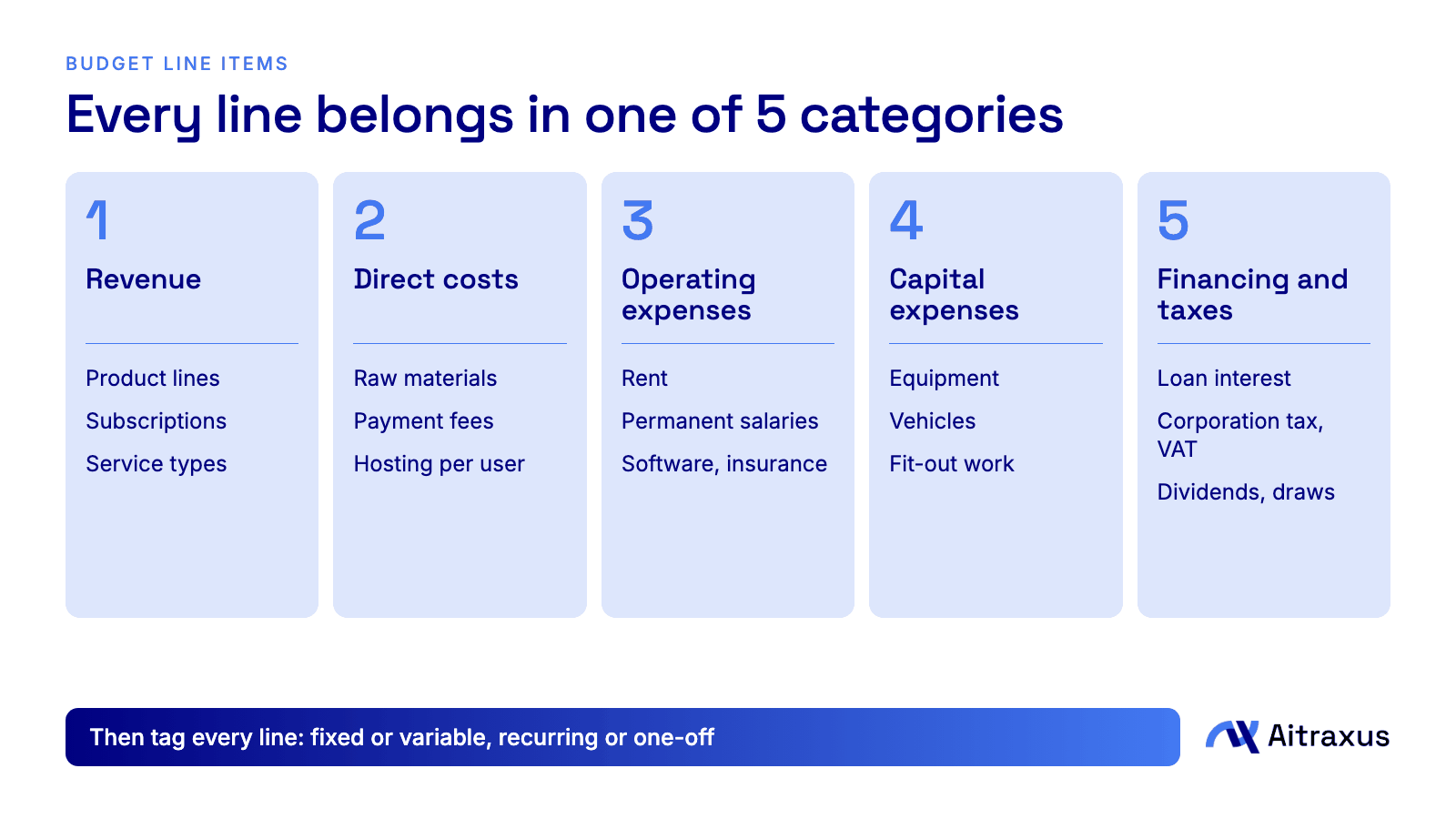
If your budget categories are messy, our guide to budget line items explains a clean structure.
2. Separate run spend from change spend
Split the budget into two parts:
| Run the business | Change the business | |
|---|---|---|
| What it funds | Keeping current operations going: salaries for current roles, rent, existing software, routine marketing | Strategic initiatives: new markets, new products, capability building, transformation |
| How it is set | Mostly from history, challenged for waste | From strategic priorities, rebuilt each year |
| Who owns it | Department heads | Initiative owners, reviewed by leadership |
| How it is reviewed | Monthly variance against plan | Quarterly against milestones and results |
This split does two things. It stops strategic money from quietly disappearing into operations, and it gives you a clear number for how much you are really investing in change. If the change budget is very small compared with the ambition in the strategic plan, the plan is not funded. Our comparison of zero-based vs incremental budgeting helps decide how hard to challenge the run budget.
3. Allocate by priority, and decide what to stop
Rank initiatives by strategic importance, then fund from the top down until the change budget runs out. Initiatives below the line are not approved this year. Funding three initiatives properly is better than funding eight badly.
For each new initiative, ask what it displaces. If nothing stops, check whether the people who will do the work really have the time. Our guide to resource allocation as strategic decisions covers how to run this conversation, and calculating ROI on strategic initiatives covers the business case for each one.
4. Plan scenarios
A single budget assumes one future. Build at least two or three scenarios, for example a base case, a downside case where revenue falls 15%, and an upside case. For each, decide in advance which initiatives continue, which pause and which accelerate.
Scenario planning is less common than it should be. In a 2014 FM Magazine report on planning, forecasting and budgeting, only 46% of CGMA designation holders said scenario planning was part of their organisation's planning process. The same article quotes Eniola Ogunbodede's view that forecast data should show how a proposed strategy will translate into results.
5. Review actuals against plan and reallocate quarterly
Each month, compare actual spending with the plan for each initiative. Each quarter, look at spending and results together:
- Which initiatives are spending to plan and moving their measures?
- Which are underspending, often a sign they are stalled?
- Which are overspending without results?
- Where should money move?
Make the reallocation decisions in the same meeting as strategy decisions, with the same people. Our guide to quarterly strategy reviews has a full agenda.
Mapping strategic objectives to budget lines and measures
The table below shows what the link looks like in practice. Each row reads left to right, from the objective to the money to the measure that shows whether the money worked.
| Strategic objective | Initiative | Budget lines | Measure |
|---|---|---|---|
| Grow export revenue | Enter the German market | Trade fairs, local sales agent, product certification, translation, 50% of export manager salary | Export revenue, number of German distributors |
| Improve delivery margin | Automate production planning | Planning software licence, implementation partner, staff training | Delivery margin, on-time delivery rate |
| Retain key customers | Account management programme | Account manager hire, customer events, CRM upgrade | Revenue retention of top 20 customers |
| Build a stronger team | Leadership development | External training, coaching, time of participants | Internal promotion rate, staff turnover |
| Reduce operational risk | Backup supplier programme | Supplier audits, qualification samples, travel | Share of critical parts with a second source |
Each measure should be one you already track or can start tracking before the year begins. See how to write measurable strategic goals.
Worked example: a 45 person manufacturer
This example is fictional, for illustration.
A precision parts manufacturer has annual revenue of EUR 6 million and a total budget of EUR 5.4 million. Its strategy has three pillars: grow exports, improve margin and reduce supplier risk.
When the leadership team split the budget, they found EUR 5.25 million was run spend and only EUR 150,000 was clearly tied to strategic initiatives. Keeping the EUR 5.4 million total, they rebuilt the change budget at EUR 420,000 by cutting two legacy software subscriptions, merging two routine trade fair visits into one, and moving part of one manager's time to the export initiative.
| Initiative | Planned (EUR) | Actual after Q2 (EUR) | Measure after Q2 |
|---|---|---|---|
| Enter the German market | 180,000 | 95,000 | Two distributors signed, target four by year end |
| Automate production planning | 160,000 | 40,000 | Software selected, implementation not started |
| Backup supplier programme | 80,000 | 52,000 | Second source for 6 of 12 critical parts |
| Total change budget | 420,000 | 187,000 |
At the second quarterly review, the production planning initiative was clearly behind: 25% of the budget spent at the half-year point, and no implementation date. The team moved EUR 40,000 from it to the German market initiative, which was ahead of plan and needed a second trade fair. The planning project was rescheduled to start in the third quarter with a smaller first phase.
They also prepared a downside scenario. If revenue fell 15%, the backup supplier programme would continue, the German market initiative would pause after the second fair, and production planning would wait until the next year.
Common mistakes
- Building the budget before the strategy is agreed, so the strategy has to fit whatever money is left.
- Mixing run and change spend, so nobody knows how much is being invested in the strategy.
- Leaving out internal labour, which makes initiatives look cheaper than they are.
- Spreading money thinly across too many initiatives.
- Adding new initiatives without stopping anything.
- Reviewing the strategic budget once a year.
- Leaving finance out of strategic planning until the end.
- Treating underspend as good news, when it often means an initiative has stalled.
Strategic budgeting checklist
- Every strategic objective has named initiatives.
- Every initiative has budget lines, including internal labour.
- Run and change spend are shown separately.
- Initiatives are ranked, and the ones below the funding line are written down.
- Every new initiative has a decision on what it displaces.
- At least two scenarios exist, with a decision on what pauses in the downside case.
- Actuals are compared with plan monthly, per initiative.
- Reallocation is decided quarterly, in the strategy meeting.
Link budget lines to initiatives in Aitraxus
In Aitraxus, the budget sits inside the strategy rather than in a separate spreadsheet. The Budget Planner links budget lines to the initiatives they fund, so you can see the cost of each initiative and roll it up to goals and pillars.
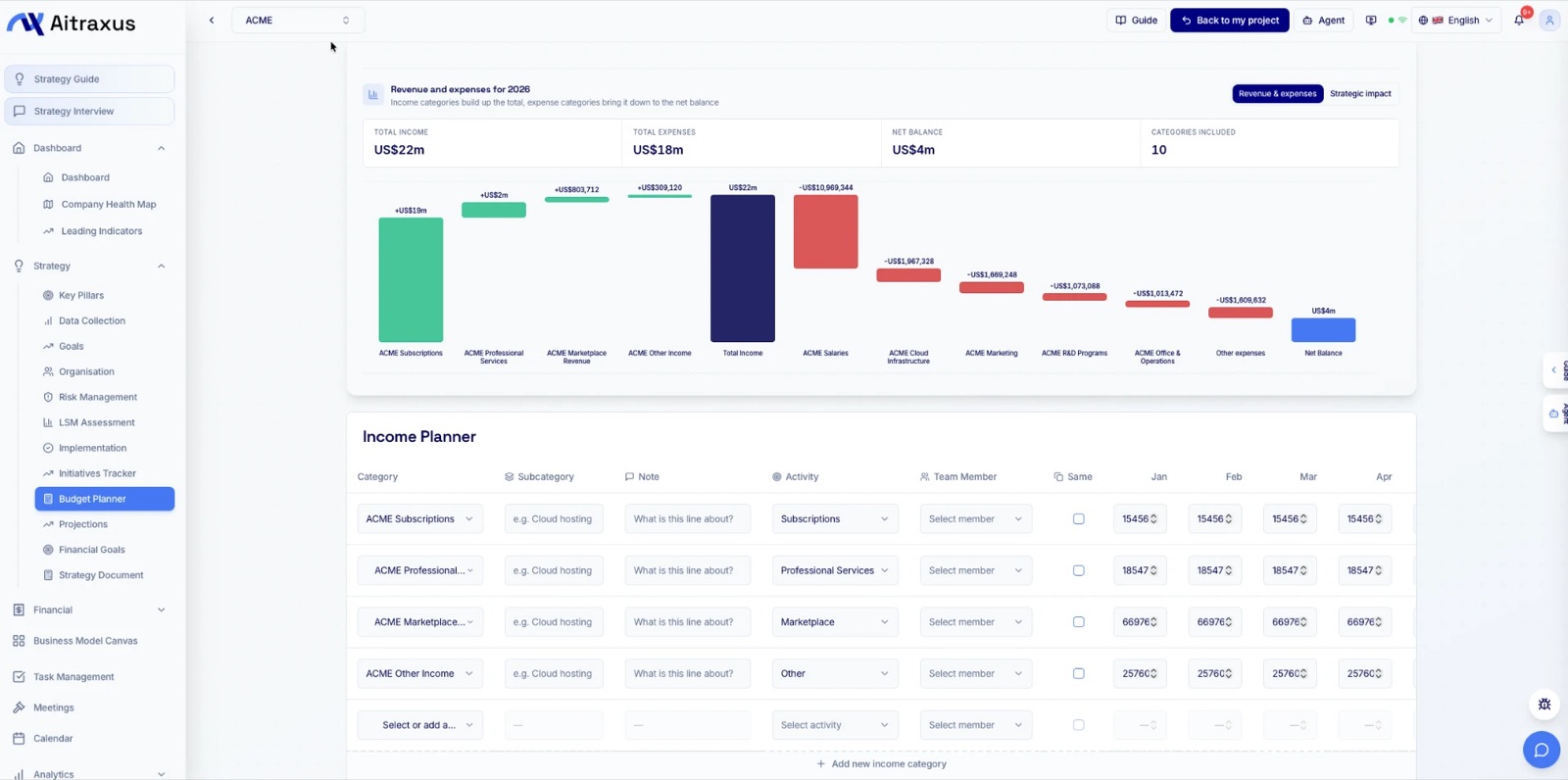
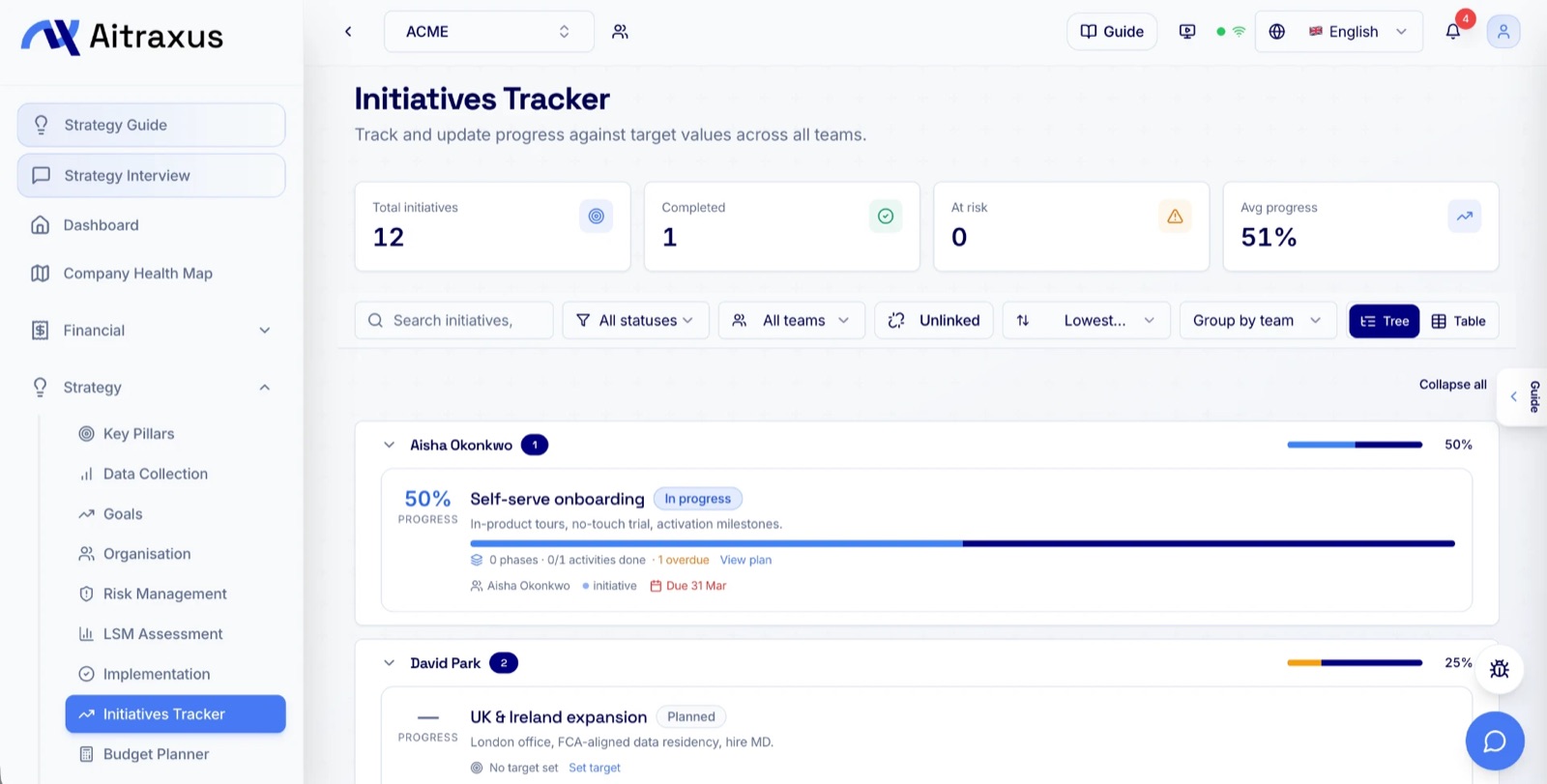
Actual transactions sit next to the plan, so the monthly comparison does not need a separate export. You can build budget scenarios and compare them before deciding what to fund. The Initiatives Tracker shows progress for each initiative, so spending and progress can be read together in the quarterly review.
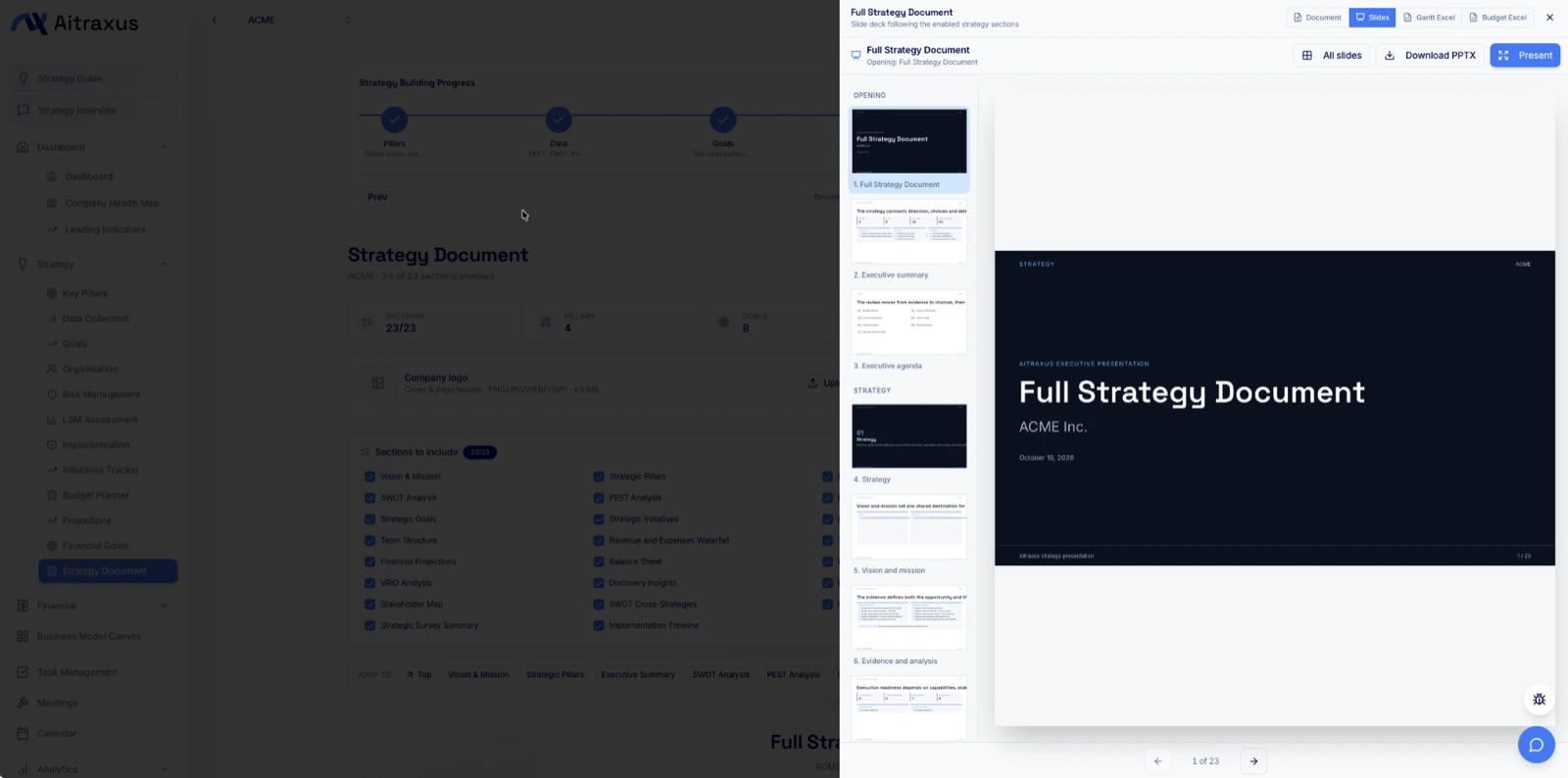
When it is time to report, board slides are generated from the same live data, so the numbers in the boardroom match the numbers in the plan.
Sources
- Mankins and Steele, "Turning Great Strategy into Great Performance", HBR, 2005, summary also hosted by Bain and Company
- Hope and Fraser, "Who Needs Budgets?", HBR, 2003
- Tysiac and Hagel, "How to better connect, and communicate, planning, forecasting and budgeting", FM Magazine, 2014
Frequently asked questions
How do you link a budget to a strategic plan?
List the initiatives behind each strategic objective, give each initiative its own budget lines, keep run and change spend separate, and review actual spending against both the plan and the results every quarter.
What is strategic budgeting?
Strategic budgeting means allocating money from strategic priorities rather than from last year's figures. The budget for change is built from the initiatives the strategy requires, then reviewed and reallocated during the year.
What is the difference between run and change budgets?
The run budget keeps current operations going. The change budget funds the initiatives that move the strategy. Keeping them separate shows how much you are really investing in change.
How often should the budget be reviewed against strategy?
Compare actuals with plan monthly for each initiative, and make reallocation decisions quarterly in the same meeting where strategy is reviewed.
How does financial planning support strategy?
It turns priorities into funded commitments. When every initiative has a budget, an owner and a measure, the organisation can see whether money is going where the strategy says it should.
Try Aitraxus free and open the ACME demo project to see budget lines, actual spending and scenarios linked to the initiatives they fund.