Strategic Pillars: What They Are, How to Choose Them and Examples
Strategic pillars are the 3 to 5 areas where you must excel to reach your vision. Learn how to choose them, link them to goals and see examples.
Strategic pillars are the three to five areas where an organisation must excel to reach its vision. They sit between the vision and the goals: the vision says where you are going, the pillars say where you will concentrate effort, and the goals say how you will measure progress.
This guide explains what strategic pillars are, how they differ from values, goals and enablers, how to choose them in five steps, and shows real examples from organisations that publish theirs.
What are strategic pillars?
The Balanced Scorecard Institute describes strategic themes as the main areas where an organisation must excel to achieve its vision, and notes that they are sometimes called pillars of excellence. It recommends breaking a vision into three or four of them, each with a measurable strategic result.
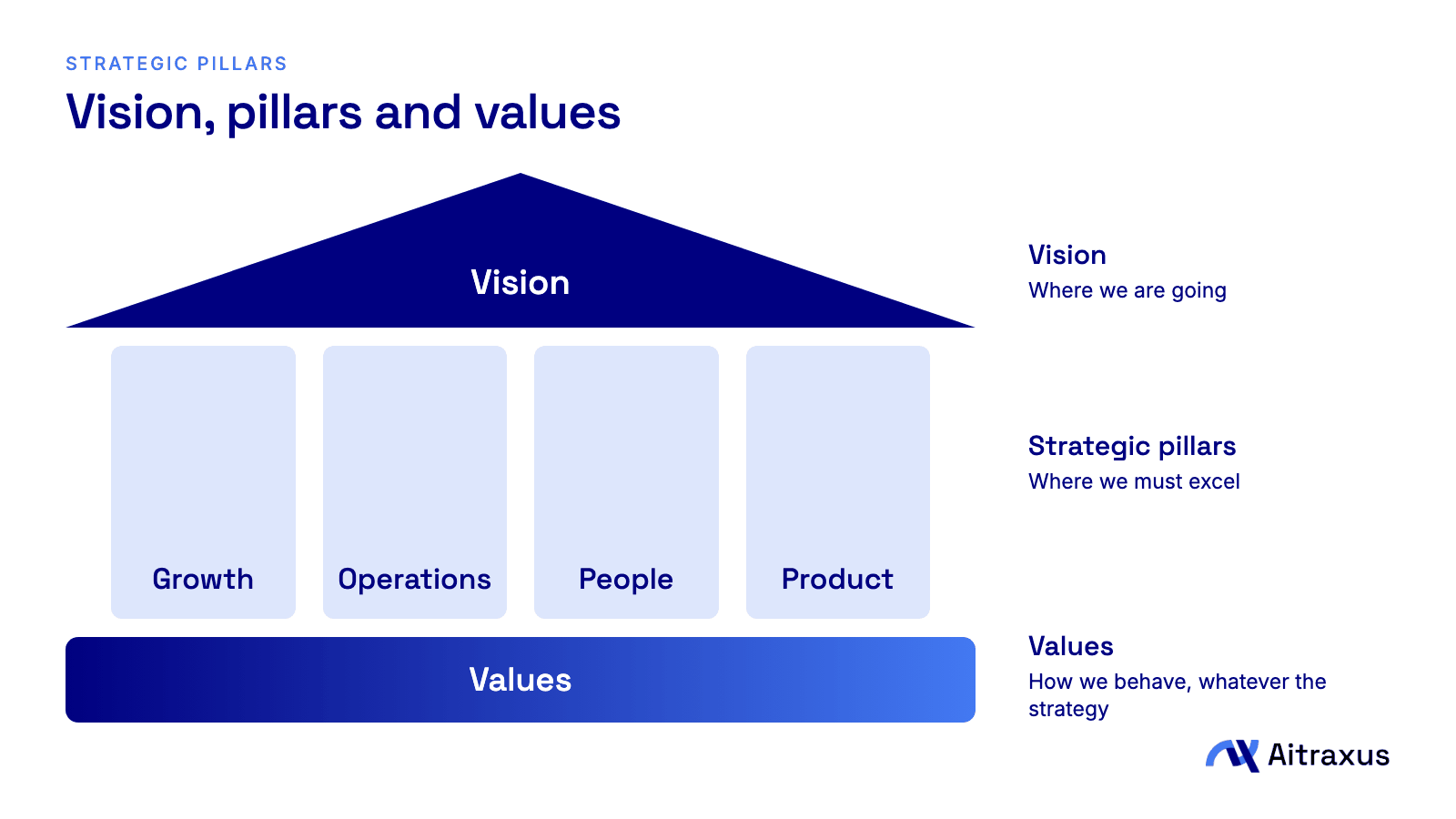
A useful way to picture this is a house. The vision is the roof, the pillars hold it up, and the values are the foundation everything stands on.
Pillars vs values, goals and enablers
These terms are often mixed up, which is one reason many strategies feel vague.
| Term | What it is | Example |
|---|---|---|
| Vision | The future you are aiming for | Be the leading regional logistics software provider |
| Strategic pillar | An area where you must excel to get there | Customer retention |
| Strategic result | The measurable outcome for a pillar | Most customers renew every year |
| Goal | A specific, dated target under a pillar | Cut annual churn from 18% to 10% by 2028 |
| KPI | The number you track | Monthly churn rate |
| Value | How you behave, whatever the strategy | We tell customers the truth |
| Enabler | A capability that supports every pillar | Data, people, technology |
Values and enablers matter, but they are not pillars. A pillar is a choice about where to compete or improve. If every organisation in your sector could claim it, add a specific result to make it yours.
How many strategic pillars should you have?
Three to five is the most common range, and the Balanced Scorecard Institute suggests three or four. Fewer pillars make focus possible, and focus is what most strategies lack.
Research from Donald Sull and Rebecca Homkes, reported by London Business School in 2015, surveyed more than 11,000 managers at over 400 companies. It found that only a third of senior managers could correctly name their firm's top three priorities. A short list that people can remember is the first step toward a strategy they can carry out.
How to choose strategic pillars in 5 steps
Step 1: Finish your analysis first
Pillars chosen before you understand your market are guesses. Complete your SWOT, PEST and competitive analysis, and look at what your customers and staff told you.
Step 2: List your strategic options
Write down 10 to 15 areas where you could focus, such as entering a new market, improving retention, building a product line or reducing cost to serve.
Step 3: Apply three filters
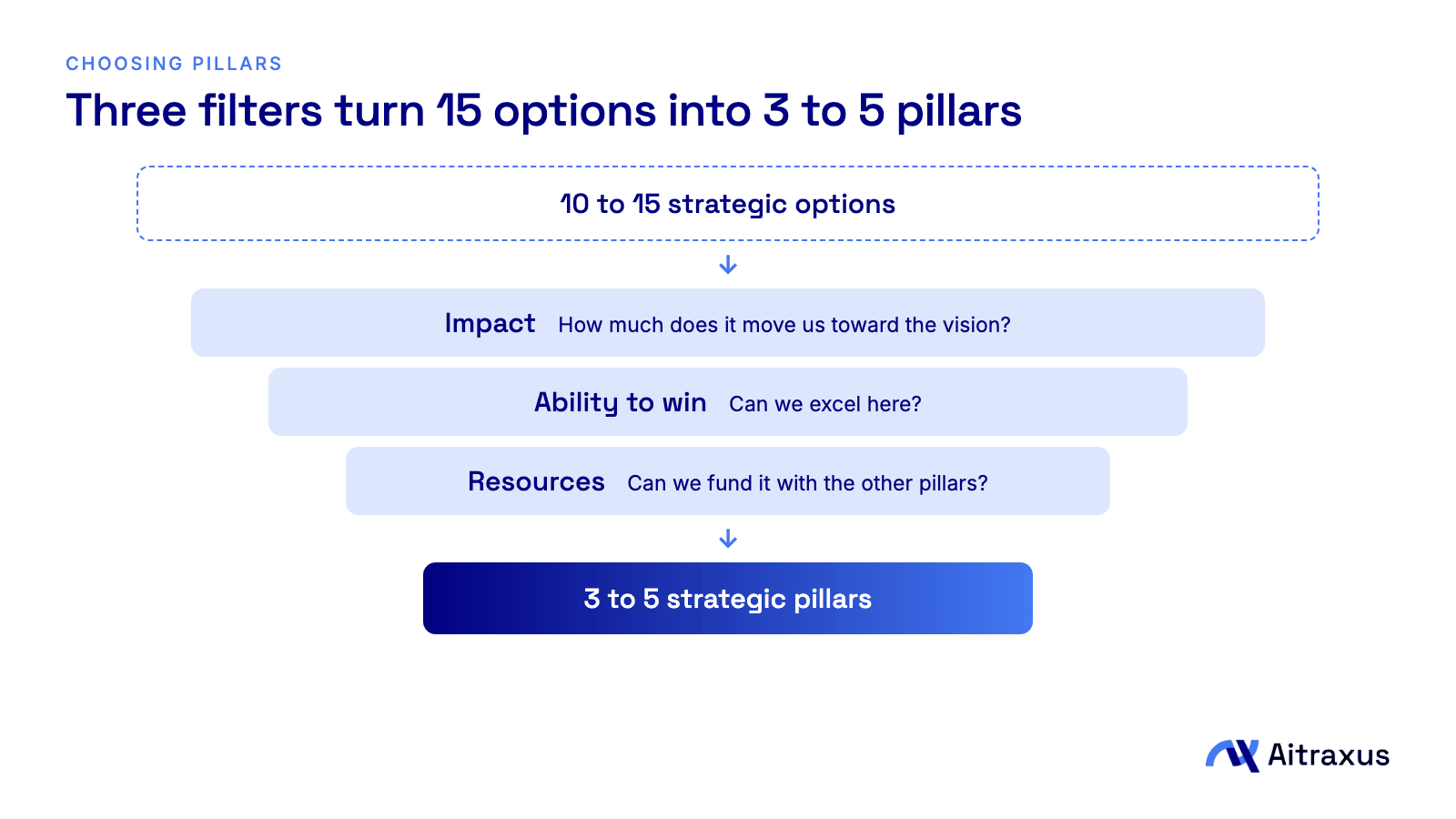
- Impact: how much does this move us toward the vision?
- Ability to win: do we have, or can we build, the capabilities to excel here?
- Resources: can we fund it alongside the other pillars?
Step 4: Force a choice
Keep three to five options and drop the rest, at least for this planning period. Write down what you will not do, so that the choice is visible.
Step 5: Name each pillar and give it a result
Use names that say something specific, then attach a measurable result to each. "Growth" says little. "Recurring revenue from mid-sized clients" tells people where to look.
Strategic pillar examples
These organisations publish their strategic priorities, which makes them useful references.
| Organisation | Type | Published priorities |
|---|---|---|
| APSO, Strategy 2025 to 2032 | Sports body | Four pillars: Smarter Foundations, Stronger Together, Open Doors, Growth from Within |
| IFRC, Strategy 2030 | Humanitarian network | Five global challenges, supported by seven transformations |
The IFRC example shows a useful pattern for NGOs: priorities that describe the change you pursue, paired with enablers that describe how the organisation must change to deliver it.
Here are illustrative pillars for three kinds of organisation.
| Organisation | Example pillars |
|---|---|
| SME software company | Recurring revenue from mid-sized clients; customer retention; self-service product |
| Regional manufacturer | Operational efficiency; export growth; skilled workforce |
| Youth skills NGO | Employer partnerships; proven impact; diversified funding |
From pillars to goals and KPIs
Each pillar should cascade into two to four goals, and each goal into one or two KPIs. That chain is what lets a board see whether a pillar is working.
| Pillar | Goal | KPI |
|---|---|---|
| Customer retention | Cut annual churn from 18% to 10% by 2028 | Monthly churn rate |
| Customer retention | Raise onboarding completion to 90% | Share of new accounts completing onboarding |
| Self-service product | Launch self-service sign-up this year | Self-service sign-ups per month |
Pillars usually hold for the length of the strategy, often three to five years as a rule of thumb, while goals and KPIs are reviewed every year.
Common mistakes
- Copying a generic framework instead of making a choice.
- Choosing pillars that are really processes, such as "reporting".
- Having too many pillars, so nothing gets enough attention.
- Setting pillars before finishing the analysis.
- Giving a pillar no measurable result.
- Mixing pillars with values or enablers.
- Naming pillars so broadly that they guide no decisions.
Define and track strategic pillars in Aitraxus
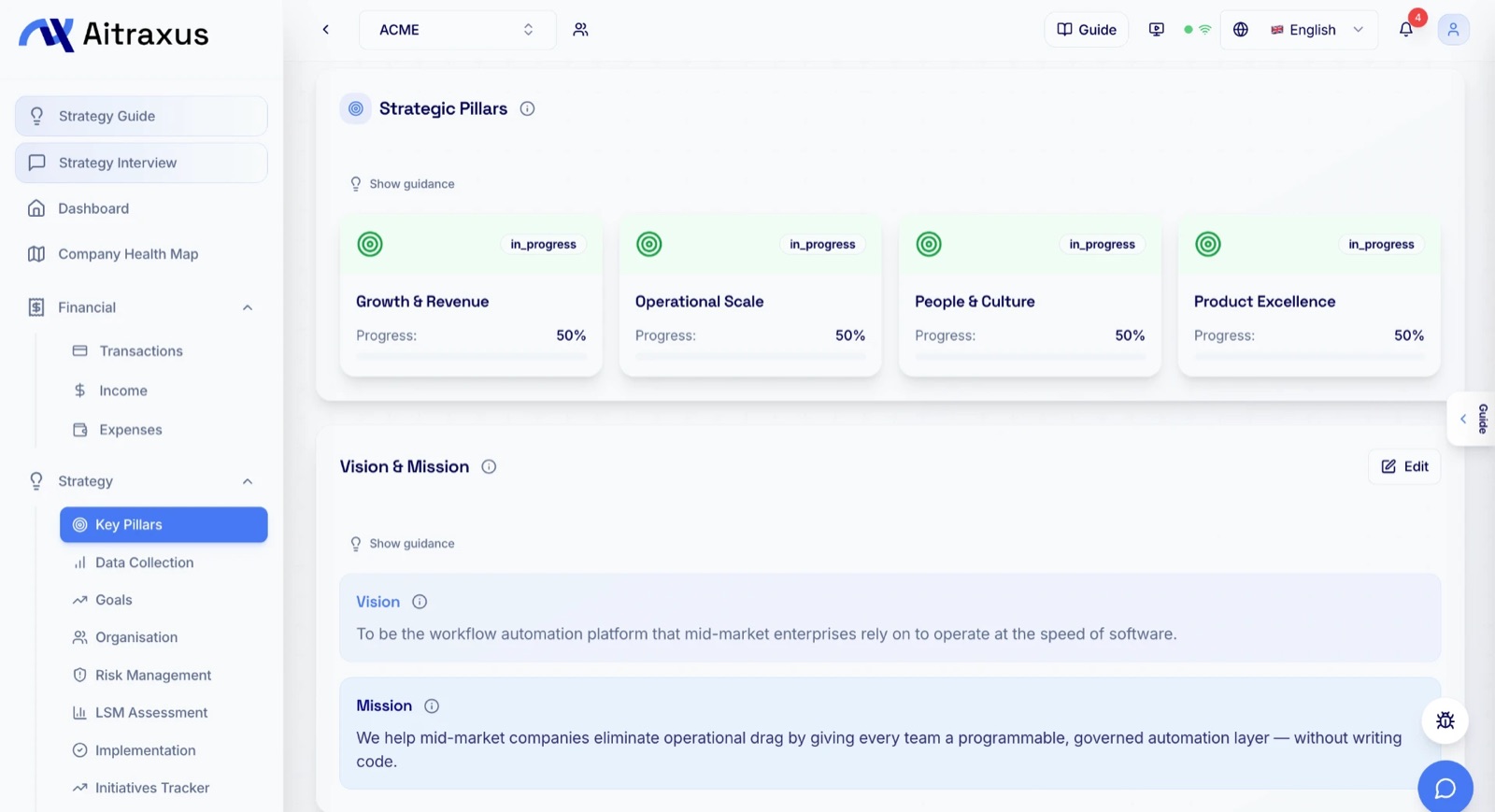
In Aitraxus Key Pillars, you review the AI suggested vision and mission, agree the wording with your leadership team, and add or rename pillars such as Growth, Operations, People and Product. When you link goals to each pillar, pillar progress and status are calculated automatically.
For more, read our guide to the strategic planning process and what makes a strategic pillar durable across economic cycles.
Sources
- Balanced Scorecard Institute, Strategic Themes: How Are They Used and Why?
- London Business School, Two-thirds of senior managers can't name their firm's top priorities, 2015
- APSO, Strategy 2025 to 2032
- Prepare Center, IFRC Strategy 2030
Frequently asked questions
What are strategic pillars?
They are the three to five areas where an organisation must excel to reach its vision. Each pillar should have a measurable result and a few goals under it.
How many strategic pillars should a company have?
Three to five is the usual range. Fewer pillars make focus easier, and the Balanced Scorecard Institute suggests three or four.
What is the difference between strategic pillars and values?
Pillars are choices about where to focus effort to reach the vision. Values describe how people behave, whatever the strategy.
Are strategic pillars the same as strategic priorities?
They are often used to mean the same thing. Both describe the few areas the organisation chooses to focus on during a planning period.
What are examples of strategic pillars for a nonprofit?
A youth skills NGO might choose employer partnerships, proven impact and diversified funding, supported by enablers such as people and data.
Try Aitraxus free and open the ACME demo project to see pillars linked to goals and progress.