SWOT Analysis: How to Do One Step by Step, With TOWS Matrix and Example
How to do a SWOT analysis step by step: gather evidence, prioritise, turn it into strategy with a TOWS matrix, check an AI draft, plus an example and checklist.
A SWOT analysis is a summary of an organisation's internal strengths and weaknesses and the external opportunities and threats it faces, usually laid out as a 2x2 grid. Done well, it is a short list of evidence-backed facts that point to strategic choices. Done badly, it is four boxes of opinions such as "strong team" and "competitive market" that nobody uses again.
This guide covers what a SWOT is and where it comes from, how to do one step by step, how to avoid generic output, how to turn it into strategy with a TOWS matrix, how to use AI to draft it quickly and check the result, a worked example, common mistakes and a checklist.
What is a SWOT analysis?
SWOT stands for strengths, weaknesses, opportunities and threats. The four quadrants split along two lines: what sits inside the organisation and what sits outside it, and what helps and what hurts.
| Helpful | Harmful | |
|---|---|---|
| Internal (you control it) | Strengths | Weaknesses |
| External (you respond to it) | Opportunities | Threats |
Strengths and weaknesses are about your own capabilities, resources, costs and results. Opportunities and threats are about markets, customers, competitors, regulation and technology. A common error is to mix the two: "a growing market" is an opportunity, not a strength, even if you are well placed to serve it.
A SWOT is a summary tool. It works best at the end of analysis, not as a replacement for it. That is why most strategy processes, including our strategic planning process guide, place it after tools that study the outside world and your own capabilities.
Where SWOT comes from
The origin of SWOT is often stated with confidence and rarely with evidence. It is frequently credited to Harvard Business School or to a single consultant. The most thorough study we found is a historical reconstruction by Richard Puyt, Finn Birger Lie and Dag Øivind Madsen in the Journal of Management History (published online 2024). Based on archive material, they conclude that:
- The "SOFT approach" was developed at the Stanford Research Institute (SRI) in the mid 1960s.
- Strengths, weaknesses, opportunities and threats were first published together in a 1967 SRI report, under the label gap analysis.
- The present-day 2x2 matrix first appears in John Argenti's book Systematic Corporate Planning (1974).
- They reject the claim that SWOT originated at Harvard.
The step from SWOT to strategy was formalised by Heinz Weihrich in "The TOWS Matrix: A Tool for Situational Analysis", published in Long Range Planning in 1982. We cover that matrix below.
How to do a SWOT analysis, step by step
The order matters. Inputs first, then the matrix, then the choices.
1. Set the question
A SWOT without a question produces a list about everything. The strategy writer Roger Martin argues that strengths and weaknesses only have meaning relative to a specific choice about where to play and how to win. So frame the SWOT around a decision: "Should we enter the public sector market?" or "How do we grow margin over the next three years?" A strength for one question can be irrelevant for another.
2. Gather the inputs
Collect evidence before anyone writes a sticky note.
- External: trends from a PEST analysis, market structure from Porter's Five Forces, competitor moves, customer feedback.
- Internal: financial results, margins by product or customer, churn, delivery times, staff turnover, and an honest view of which resources are hard to copy, for example with the VRIO framework.
Ask each participant to send their top three items per quadrant before the session, each with evidence. Collate them anonymously. Where several people agree, you have signal. Where one voice dominates, you have something to test.
3. Draft items with evidence
Each item gets one line and at least one piece of evidence: a metric, a customer quote, a competitor benchmark or a documented capability. Items without evidence go into a separate "hypotheses" list, not into the main grid.
4. Challenge each item
For every strength, someone from another function tries to disprove it. Finance tests what Sales says about customer loyalty. Operations tests what Marketing says about speed. Also check the internal and external split, and check that a strength is a capability, not just an outcome. "Happy customers" is an outcome. "An onboarding process that gets new clients live in five days" is a capability.
5. Prioritise
Cut each quadrant to three to five items, ranked by impact on the question you set. A grid with twenty items per box tells you nothing about what matters.
6. Ask "so what?"
For each remaining item, ask what it means for the decision. If nobody can answer, the item is operational, not strategic. Move it off the grid and hand it to the right manager. Then move on to the TOWS step.
How to avoid generic SWOT output
Generic output has three causes: no evidence, no specificity and no prioritisation. The fix is to apply a simple test to every line.
| Generic item | Specific, evidence-backed item |
|---|---|
| Strong brand | 62% of new clients last year came from referrals (CRM data) |
| Limited budget | Cash covers 4 months of fixed costs, so any new initiative must pay back within a year |
| Growing market | Two regional hospitals tender facility contracts in 2027, worth more than our current annual revenue |
| Competition | A national competitor opened a branch in our city in March and is pricing 15% below us |
Three rules keep the grid honest:
- Evidence: no metric, quote or benchmark, no place in the grid.
- Specificity: name the customer group, product, region or number.
- Prioritisation: three to five items per quadrant, ranked.
Turning SWOT into strategy: the TOWS matrix
The grid is the input. The strategy comes from pairing quadrants. Weihrich's TOWS matrix does this by matching each internal factor with each external one, which gives four kinds of strategy.
| Opportunities | Threats | |
|---|---|---|
| Strengths | SO strategies: use strengths to capture opportunities | ST strategies: use strengths to reduce threats |
| Weaknesses | WO strategies: use opportunities to fix weaknesses | WT strategies: reduce weaknesses to avoid threats |
How to work through it:
- Take your top strengths and top opportunities and ask, for each pair, "How do we use this strength to capture this opportunity?"
- Repeat for the other three pairings.
- Write each answer as a candidate initiative, not a description.
- Score candidates by impact and effort, and keep the few that fit your strategy.
- Give each one an owner, a date and a budget line.
A simpler test also works. After the session, the team should be able to finish three sentences: "We will double down on X because our strength in Y gives us an edge." "We will stop or deprioritise Z because our weakness in W makes it unlikely to succeed." "We will invest in fixing A because otherwise we are exposed to threat B." If you can write them, you have choices. If you cannot, you have a grid.
Surviving initiatives usually group into a few themes, which become your strategic pillars. WT items often belong in your risk register as well.
Using AI to draft a SWOT quickly, and how to check it
AI can produce a first SWOT draft in minutes from interview notes, financial summaries and market research. That saves the extraction time that long workshops spend on getting people to say what they already know, and leaves the meeting for judgement. A practical format looks like this:
| Step | Time | What happens |
|---|---|---|
| Discovery | 10 minutes | Answer structured questions about customers, finances, capabilities and market, or upload existing analysis |
| AI draft | 5 minutes | AI drafts the four quadrants from what you provided |
| Review | 15 minutes or more | The team checks, edits, prioritises and moves on to TOWS |
The review is the part humans must own. Check an AI draft for:
- Generic lines: anything that would fit any company in your sector gets cut or rewritten with your own numbers.
- Missing evidence: every item should trace back to something you provided or can verify.
- Invented facts: AI can state market sizes or competitor moves with confidence. Verify any external claim against a real source or delete it.
- Wrong quadrant: external trends listed as strengths, or outcomes listed as capabilities.
- Blind spots: AI only knows what you gave it. Ask the team what is missing, especially uncomfortable weaknesses.
AI proposes, the leadership team decides. For more on structured interviews as an input, see AI strategy discovery interviews.
SWOT analysis example
This example is fictional, for illustration.
Northfield Facilities is a 60 person commercial cleaning and maintenance company. Its question: "How do we grow profitably over the next three years without depending on our two largest clients?"
| Quadrant | Top items, with evidence |
|---|---|
| Strengths | 62% of new clients came from referrals. Average contract renewal rate of 91% over three years. In-house HVAC technicians, which few local competitors have |
| Weaknesses | Two clients produce 48% of revenue. No digital reporting for clients, raised in 4 of the last 10 lost bids. Supervisors spend about a day a week on paper scheduling |
| Opportunities | Two regional hospitals tender facility contracts in 2027. New energy efficiency rules push building owners to service HVAC systems more often |
| Threats | A national competitor opened a local branch, pricing 15% lower. Wage costs rose faster than contract prices last year |
From the grid, the team built a TOWS view:
| Pairing | Candidate initiative |
|---|---|
| SO | Package HVAC servicing with cleaning for buildings affected by the efficiency rules |
| WO | Introduce a client reporting portal before the hospital tenders open |
| ST | Use the referral base and renewal record to win on reliability, not price, against the new competitor |
| WT | Add price indexation to new contracts so wage rises do not erode margin |
The team kept three: the HVAC package, the reporting portal and price indexation. Each got an owner, a budget line and a review date. The client concentration weakness became a goal: no single client above 20% of revenue within three years.
Common SWOT mistakes
- Starting without a question, so the grid covers everything and decides nothing.
- Mixing internal and external factors.
- Vague items with no evidence.
- Twenty items per quadrant and no ranking.
- Listing outcomes as strengths instead of capabilities.
- Accepting an AI draft without checking facts.
- Stopping at the grid, with no TOWS step, owners or budget.
- Never revisiting it, even after the market changes.
SWOT checklist
- The SWOT answers one clear strategic question.
- External inputs (PEST, Five Forces) and internal data were gathered first.
- Every item has evidence and sits in the right quadrant.
- Each quadrant has three to five ranked items.
- SO, WO, ST and WT pairings produced candidate initiatives.
- Chosen initiatives have owners, dates and budget lines.
- A review date is set.
Run a SWOT analysis in Aitraxus
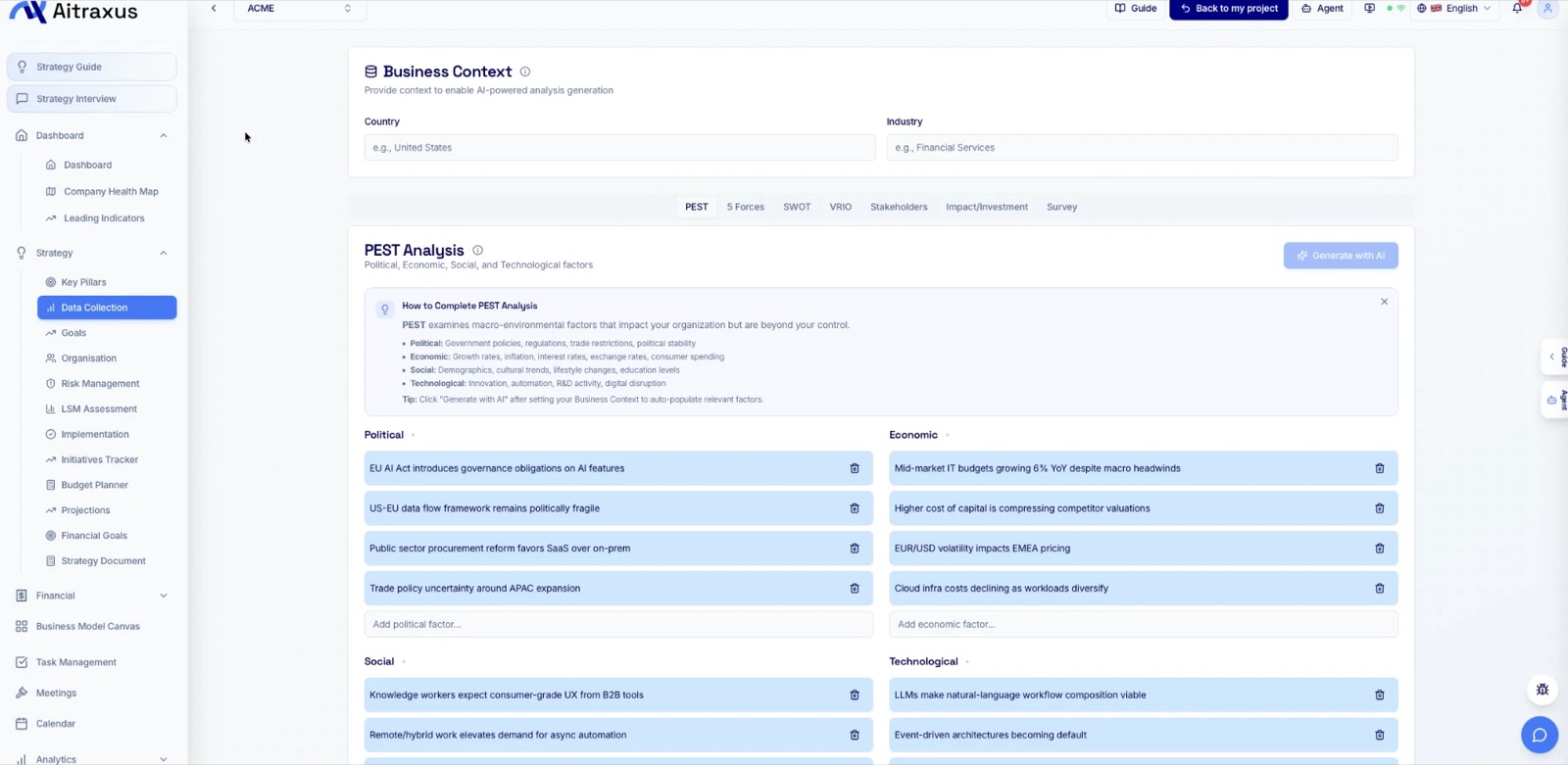
In Aitraxus, SWOT is one of the frameworks in Data Collection, alongside PEST, Five Forces and VRIO. You choose the framework, generate a first draft with AI from what your team has shared, for example in the AI discovery interview, and then edit and prioritise it together.
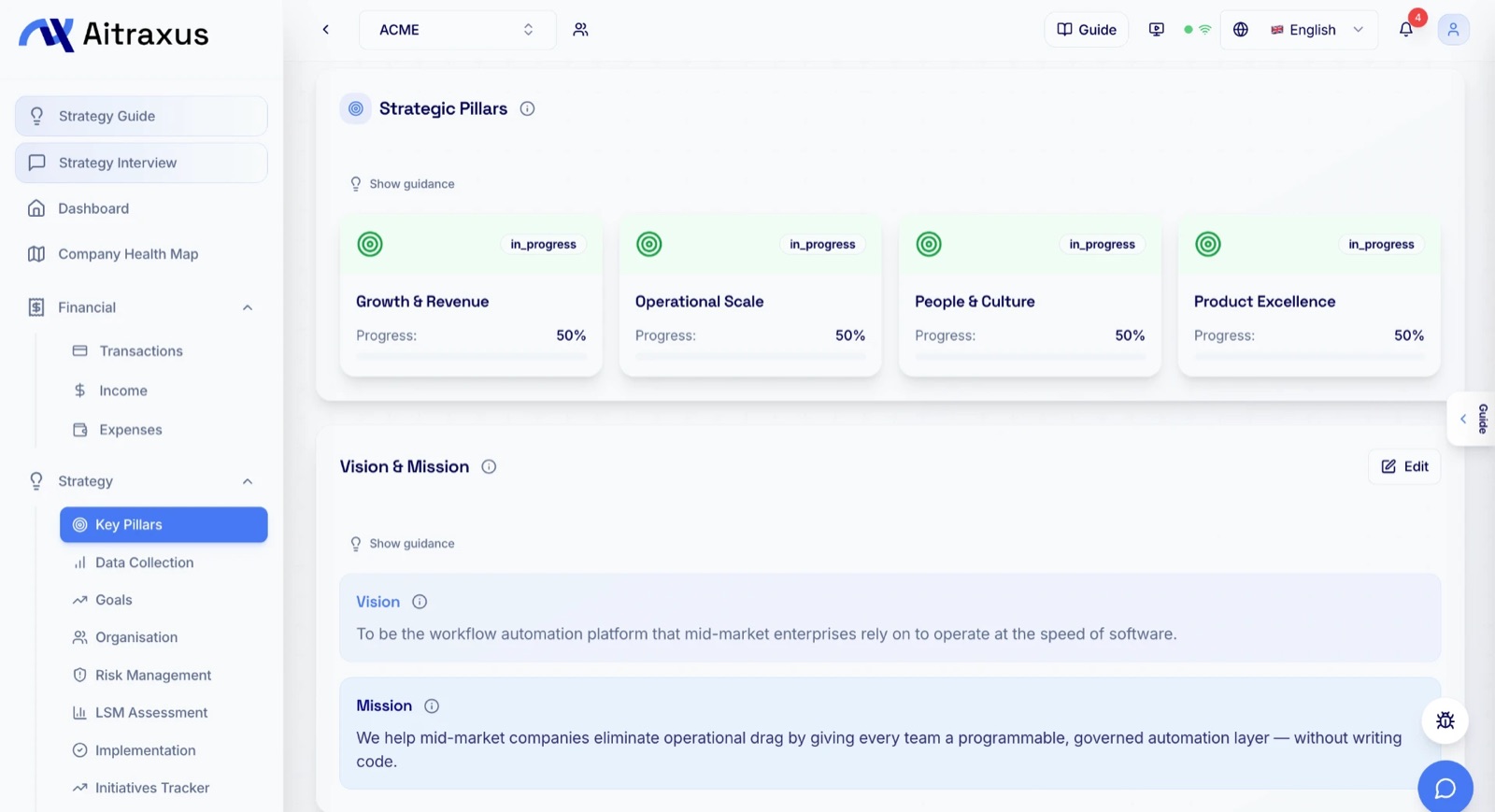
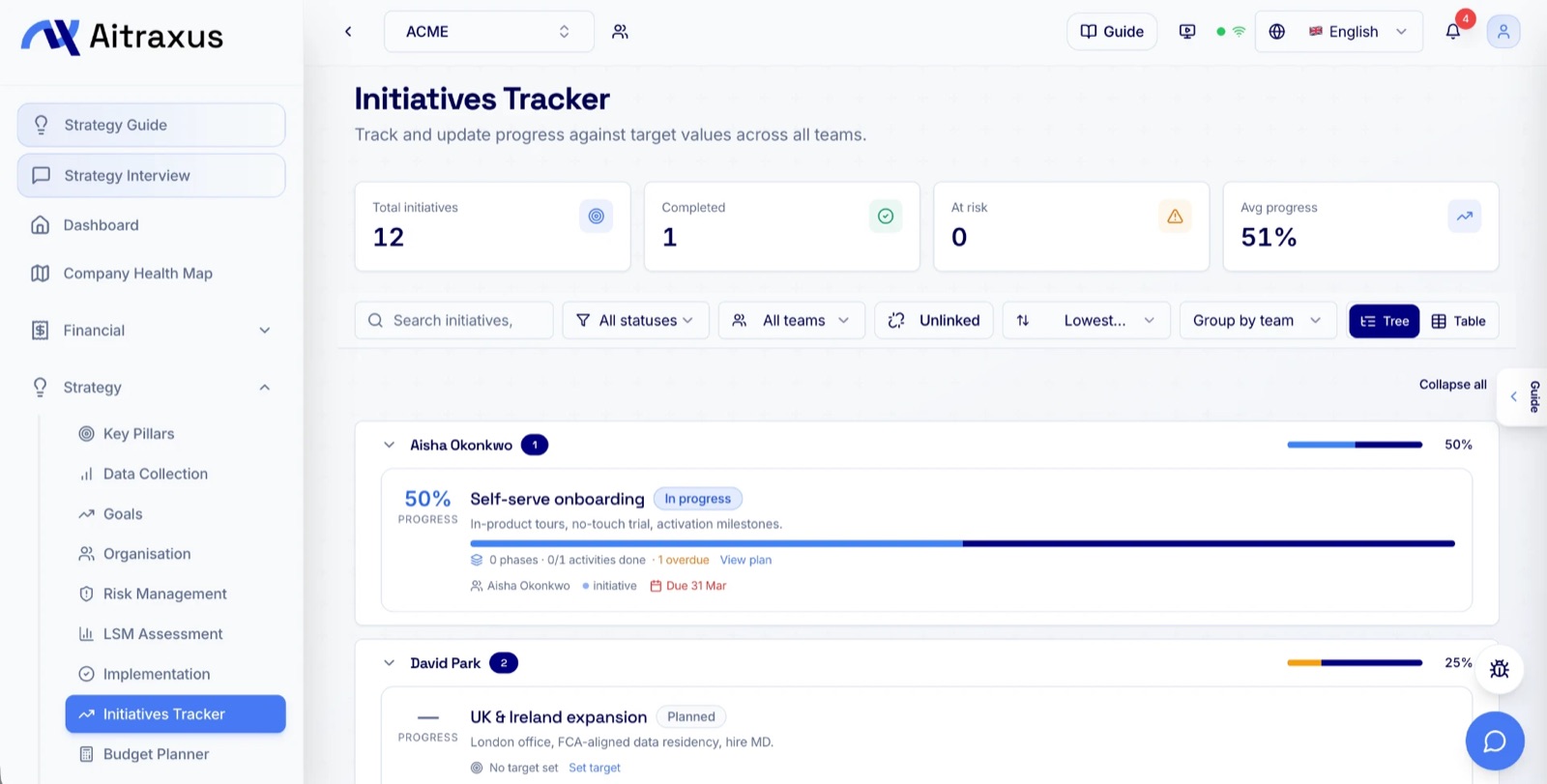
The findings then feed the next steps of the Strategy Guide: strategic pillars, goals and initiatives with owners, and a budget linked to those initiatives.
Sources
- Puyt, Lie and Madsen, "From SOFT approach to SWOT analysis, a historical reconstruction", Journal of Management History, 2024 (online), Vol. 31 No. 2, 2025
- Weihrich, "The TOWS Matrix: A Tool for Situational Analysis", Long Range Planning, Vol. 15 No. 2, 1982, pp. 54 to 66
- Roger Martin, "It's Time to Toss SWOT Analysis into the Ashbin of Strategy History", 2021
- Toolshero, TOWS Matrix explained
Frequently asked questions
How do you do a SWOT analysis?
Set the question the SWOT should answer, gather external and internal evidence, draft items with evidence, challenge them, cut each quadrant to three to five ranked items, then pair quadrants in a TOWS matrix to produce strategic options.
What is the difference between SWOT and TOWS?
SWOT lists the factors. TOWS, introduced by Heinz Weihrich in 1982, pairs them to generate strategies: SO, WO, ST and WT. SWOT is the input, TOWS turns it into options.
What is a good SWOT analysis example?
A good example names specific, evidence-backed items, such as "62% of new clients came from referrals" rather than "strong brand", and ends with initiatives. See the fictional Northfield Facilities example above.
How many points should each SWOT quadrant have?
Three to five is a practical range. Gather more if you like, but rank them and keep only those that matter for the decision in front of you.
Who invented the SWOT analysis?
It is often credited to Harvard or to one person, but the evidence is thinner than that. A 2024 historical study traces the terms to work at the Stanford Research Institute in the 1960s and the 2x2 grid to John Argenti's 1974 book.
Can AI do a SWOT analysis?
AI can produce a useful first draft quickly, but the team must check it for generic lines, missing evidence and invented facts, and make the choices that follow.
Try Aitraxus free and open the ACME demo project to see a SWOT drafted in Data Collection and carried through to pillars, initiatives and budget.