Porter's Five Forces: Definition, Examples and SME Guide
Porter's Five Forces explains how competitive an industry is. See each force, an airline and an SME example, common mistakes and limitations.
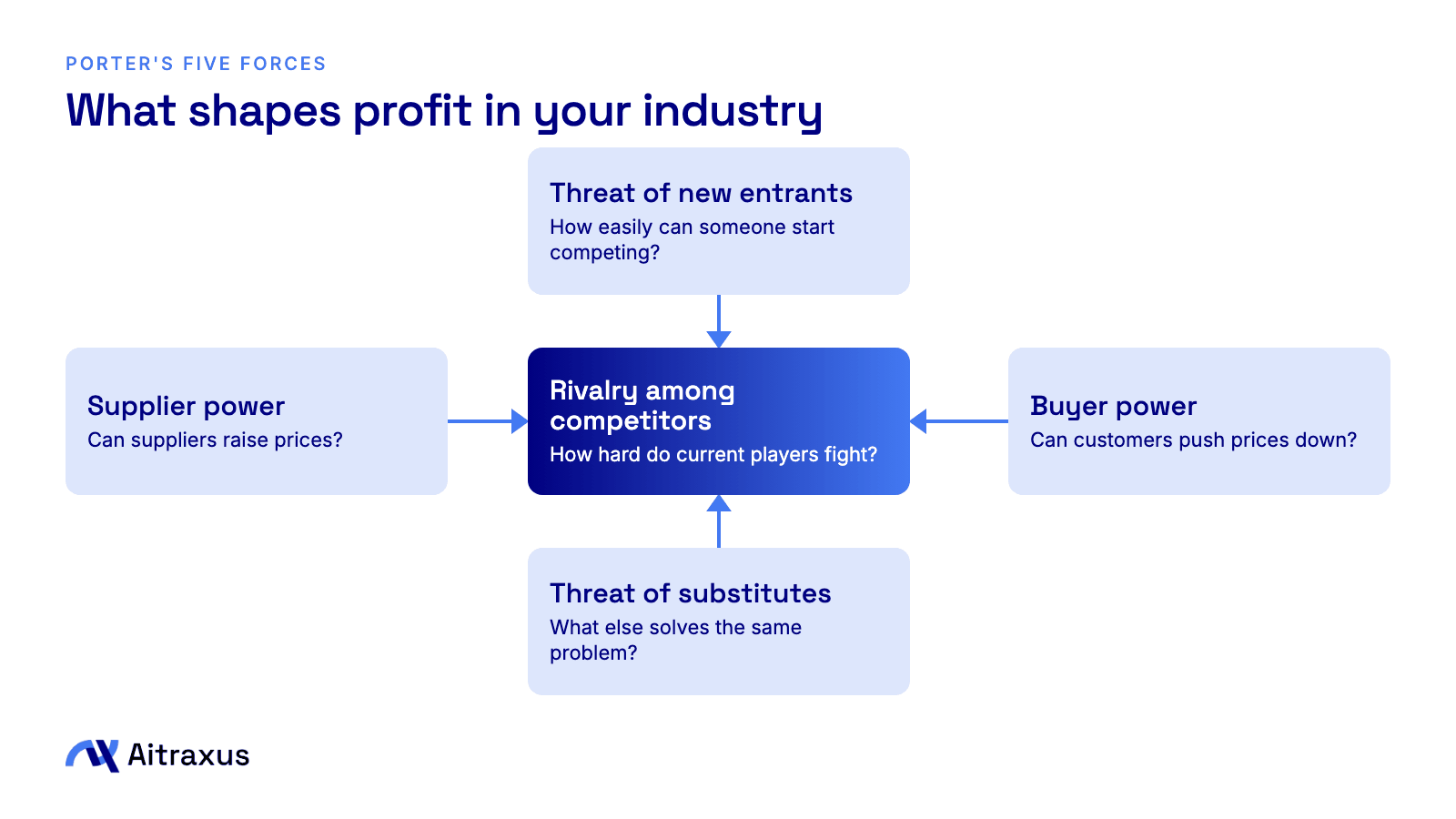
Porter's Five Forces is a framework for analysing how competitive an industry is and why some industries earn more than others. The five forces are rivalry among existing competitors, the threat of new entrants, the bargaining power of suppliers, the bargaining power of buyers, and the threat of substitutes.
Michael Porter introduced it in "How Competitive Forces Shape Strategy" in Harvard Business Review in 1979, developed it in his 1980 book Competitive Strategy, and updated it in "The Five Competitive Forces That Shape Strategy" in 2008. The central point of that update still stands: managers often define competition too narrowly, watching direct rivals and missing the wider forces that decide how much profit is available.
This guide explains each force, shows two filled-in examples and gives you a practical way for a small or mid-sized company to use it.
The five forces explained
1. Rivalry among existing competitors
How hard do current players fight? Rivalry tends to be stronger when there are many similar competitors, growth is slow, fixed costs are high, products look alike and it is costly to leave. Competing on price is the most damaging form, because it transfers profit straight to customers.
2. Threat of new entrants
How easily could someone new start competing? Look at the capital needed, economies of scale, brand loyalty, regulation, access to distribution and how existing players might react. The threat limits profit even if nobody actually enters, because prices must stay low enough to discourage them.
3. Bargaining power of suppliers
Can suppliers raise prices or cut quality without losing you? Their power grows when there are few of them, switching is costly, their input is unique or they could move into your market themselves.
4. Bargaining power of buyers
Can customers push prices down or demand more? Their power grows when they are concentrated, buy in large volumes, can switch easily, are price sensitive or could do the work themselves.
5. Threat of substitutes
What else could solve the same problem in a different way? Video calls are a substitute for business travel. A spreadsheet can be a substitute for software. Substitutes cap prices, and they are the force most often missed because they do not look like competitors.
Start by defining your industry
Most weak analyses go wrong before the first force. "Food service" is too broad to be useful, while "our street" is too narrow. Define the industry by two things: the product scope and the geographic scope. If the forces differ sharply between two segments, treat them as two industries.
Suppose you run a specialist bakery supplying cafes in one city. Your industry is wholesale artisan baked goods in that metropolitan area, not "food".
How to do a Five Forces analysis in 6 steps
- Define the industry by product and geography.
- List the participants: competitors, potential entrants, suppliers, buyers and substitutes.
- Gather evidence for each force, such as market shares, price movements, contract terms and switching costs.
- Rate each force as low, medium or high, and write down the reason.
- Identify which one or two forces matter most for your profit.
- Decide what you will do about them, then repeat the exercise once a year or when the market shifts.
Example 1: the airline industry
Airlines are the classic example of a large, essential industry that struggles to earn its cost of capital. The International Air Transport Association's value chain study, using 2022 data, reports that airline returns on invested capital have been below their cost of capital since 1996, with an economic loss of USD 45.6 billion in 2022. It points to low entry barriers, high exit barriers, high fixed costs, fragmentation and concentrated suppliers, and says that suppliers earn higher returns than airlines do.
IATA does not present this as a Five Forces analysis. The mapping and ratings below are our own reading.
| Force | Rating | Evidence |
|---|---|---|
| Rivalry | High | Fragmented market, high fixed costs, high exit barriers |
| New entrants | Medium to high | Low entry barriers overall, with some limits such as airport access |
| Supplier power | High | Concentrated suppliers that earn higher returns than airlines |
| Buyer power | High | Travellers can compare fares easily and switch |
| Substitutes | Medium | Rail on some routes and video calls for some business trips |
The lesson is that being essential does not make an industry profitable. Structure decides that.
Example 2: a regional B2B bakery
This company is fictional, for illustration. A 40 person bakery supplies cafes and hotels in one city.
| Force | Rating | Evidence | Action |
|---|---|---|---|
| Rivalry | Medium | Three similar local bakeries, with stable demand | Compete on reliability and range, not price |
| New entrants | Low | Ovens, delivery fleet and food safety approvals take time and capital | Keep contracts and service levels strong |
| Supplier power | Medium | Two flour mills, and butter prices move sharply | Qualify a second supplier, and add price review clauses |
| Buyer power | High | One hotel group is 35% of sales and buys on price | Win more mid-sized clients to reduce dependence |
| Substitutes | Medium | Frozen bake-off products are improving | Promote freshness and offer same day delivery |
The analysis points to one clear priority: buyer concentration. That is more useful than a long list of general observations.
How to use the results
A Five Forces analysis should change a decision. Three uses are the most practical:
- Position yourself where the forces are weakest. Find the customer segments or channels with less price pressure.
- Change the forces. Long-term contracts, switching costs, a stronger brand and a second supplier all shift the balance in your favour.
- Decide whether to enter or leave a market. Compare the structure of a new market with your current one before you invest.
Common mistakes
- Defining the industry too broadly or too narrowly.
- Listing factors rather than judging which ones really affect profit.
- Giving all five forces equal weight.
- Treating a growth market as automatically attractive. Porter's 2008 article warns that fast growth is not always profitable.
- Doing it once and filing it away. Industry structure changes over time.
Is government or complements a sixth force?
Some writers add government or complementary products as a sixth force. In Porter's 2008 article, government policy is discussed as something that can shift the strength of the forces, and the framework can be used to analyse complements. A common way to apply this is to ask how regulation or complements affect each of the five forces, instead of scoring them as a separate one. Barry Nalebuff and Adam Brandenburger's work on complementors is a useful companion if partners matter in your market.
Limitations of Porter's Five Forces
- It is a snapshot. It describes structure at a point in time, so fast-moving markets need more frequent updates.
- It looks outward. It says little about your own capabilities, so pair it with an internal analysis such as VRIO.
- Digital platforms stretch it. In "Pipelines, Platforms, and the New Rules of Strategy" (HBR, 2016), Van Alstyne, Parker and Choudary argue that the framework describes traditional pipeline businesses, while platforms also compete by building ecosystems and network effects.
- Data can be hard to find. Smaller markets rarely have neat statistics, so be honest about what is a judgment.
Five Forces vs SWOT vs PESTLE
| Framework | Focus | Best question | Use it |
|---|---|---|---|
| Five Forces | Industry structure | How attractive is this market? | When entering a market or reviewing pricing power |
| SWOT | Your position, inside and out | What should we do with what we have? | To sum up your findings |
| PESTLE | Wider environment | What outside trends affect us? | To feed the other two |
They work best together. Use PESTLE to scan trends, Five Forces to judge the market, and SWOT to bring it together. Our guide to PEST analysis and our framework comparison go further.
Run a Five Forces analysis in Aitraxus
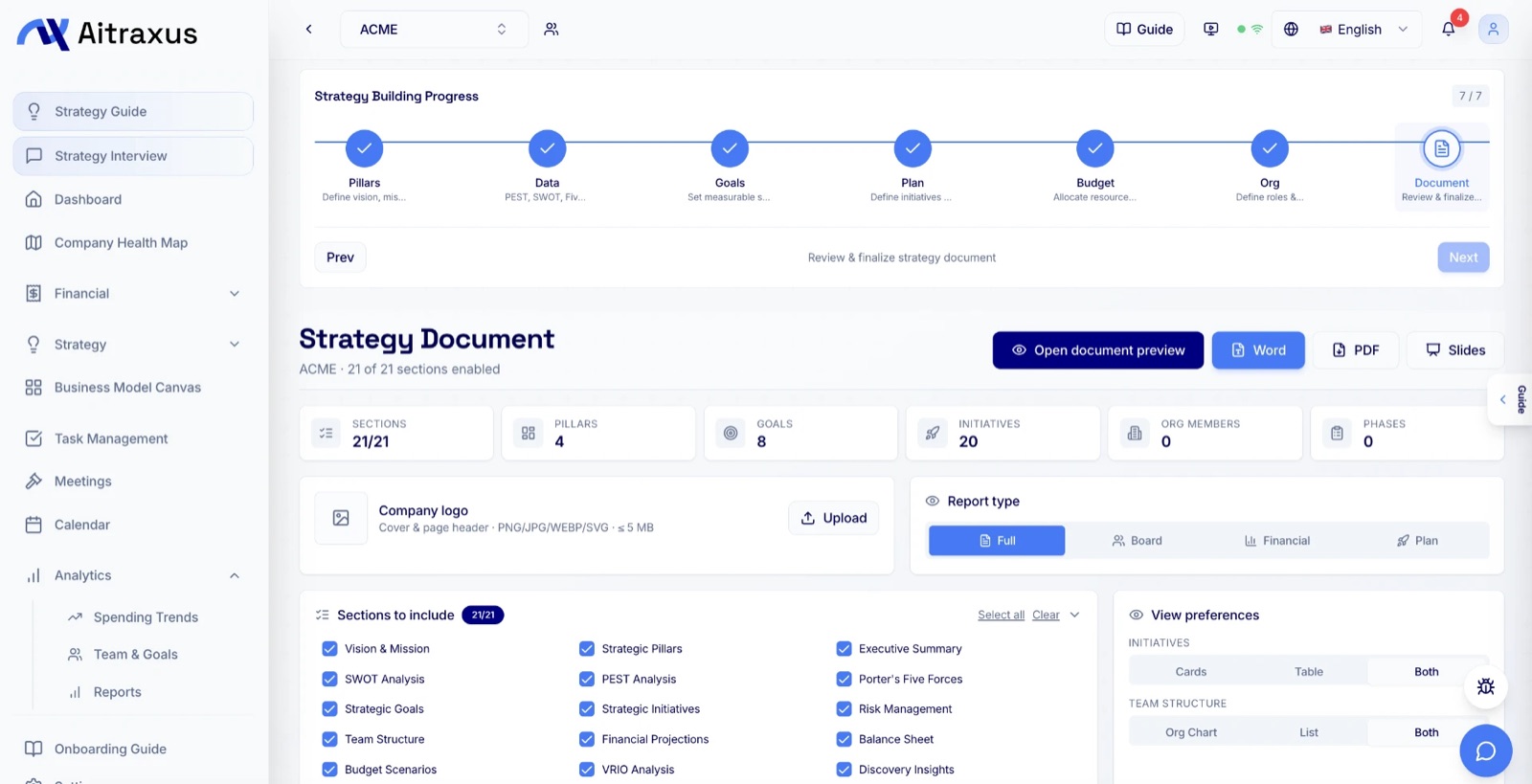
Aitraxus includes Porter's Five Forces among its guided strategic planning tools, alongside SWOT, PEST, VRIO, Business Model Canvas and Balanced Scorecard. The findings become part of a strategy with pillars, goals, budgets and owners, and appear as a section in the strategy document, so that they lead to action instead of staying in a slide.
Sources
- Porter, "How Competitive Forces Shape Strategy", HBR, 1979
- Porter, "The Five Competitive Forces That Shape Strategy", HBR, 2008
- Institute for Strategy and Competitiveness, Harvard Business School
- Van Alstyne, Parker and Choudary, "Pipelines, Platforms, and the New Rules of Strategy", HBR, 2016
- IATA, Aviation Value Chain
Frequently asked questions
What are Porter's Five Forces?
Rivalry among existing competitors, the threat of new entrants, the bargaining power of suppliers, the bargaining power of buyers and the threat of substitutes. Together they shape how much profit an industry can earn.
Who created the Five Forces and when?
Michael Porter of Harvard Business School. He introduced it in Harvard Business Review in 1979 and updated it in the same journal in 2008.
Can small businesses use Porter's Five Forces?
Yes, as long as they define their market narrowly enough. A local or niche definition often gives a small company clearer actions than a broad industry view.
What is an example of Porter's Five Forces?
Airlines are a common example: intense rivalry, powerful suppliers and price sensitive customers help explain why the industry has struggled to earn its cost of capital.
Is Porter's Five Forces still relevant for digital businesses?
Yes, with limits. It still explains pricing power and competition, but platform businesses also need analysis of network effects and ecosystems.
What is the difference between Five Forces and SWOT?
Five Forces analyses the structure of an industry. SWOT sums up one company's strengths, weaknesses, opportunities and threats, so Five Forces findings often feed into a SWOT.
Try Aitraxus free and open the ACME demo project to see these frameworks in a filled strategy.