OKR Implementation: A Practical Step by Step Guide for Small and Mid-Sized Companies
How to implement OKRs step by step: a one-quarter pilot, cadence, scoring, check-ins, good and bad key results by function, a worked example and a checklist.
OKR implementation is the work of turning a goal-setting method into a habit: a few objectives that say what matters this quarter, measurable key results that show whether you got there, and a steady rhythm of check-ins and scoring. Most of the effort is not in writing OKRs but in connecting them to your strategy and keeping the cadence going after the first quarter.
This guide explains what OKRs are, how to implement OKRs step by step in a small or mid-sized company, how they connect to strategic pillars and budgets, and what good key results look like, with a worked example, common mistakes and a checklist.
What OKRs are
OKR stands for Objectives and Key Results. John Doerr's What Matters site describes OKRs as "a collaborative goal-setting methodology".
- The objective is what you want to achieve. It should be significant, concrete and action oriented.
- The key results are how you will know you achieved it. What Matters says key results must be "measurable and verifiable", and puts it plainly: "It's not a Key Result unless it has a number."
Doerr's own formula is a useful sentence to test any OKR against: "I will [Objective] as measured by [Key Results]."
The method comes from Andy Grove at Intel, who taught it to Doerr. Doerr introduced it to Google's founders in 1999 and later wrote it up in his 2018 book Measure What Matters. Google's re:Work guide, "Set goals with OKRs", is still one of the clearest public descriptions of how Google ran them.
OKRs, KPIs and strategic goals
OKRs are not a replacement for your strategy or your KPIs. Strategic goals describe where you want to be in two to five years. KPIs track the health of the business continuously. OKRs pick the few things that must move this quarter to get closer to the strategic goals. Our guide to strategic goals vs KPIs vs OKRs explains the difference in more detail.
Committed and aspirational OKRs
What Matters distinguishes two kinds of OKR:
| Type | What it means | How to read the score |
|---|---|---|
| Committed | Something the team agrees will get done, such as a launch or a hiring target | Expected to be fully achieved. A miss needs an explanation |
| Aspirational | A stretch goal, where the path is not yet known | Partial achievement is normal and still useful |
Google's re:Work guide describes the stretch case: OKRs are graded from 0.0 to 1.0, and "the expectation is to get an average of 0.6 to 0.7 across all OKRs." If a team always scores 1.0, its goals were probably not ambitious enough.
For a first implementation, label every OKR as committed or aspirational when you write it. Otherwise a score of 0.6 will be read as success by some people and failure by others.
How to implement OKRs step by step
1. Check that you have a strategy to execute
OKRs are a tool for executing a direction, not for finding one. Before writing any OKR, the leadership team should agree on three to five strategic priorities, often called strategic pillars. If the priorities are not agreed, OKRs will produce neat goals that pull in different directions.
2. Decide the rules before the first cycle
Write down three decisions and share them:
- Cycle length. A quarter is the common choice.
- Scoring. A 0.0 to 1.0 scale, with committed and aspirational OKRs marked.
- Link to pay. Google's re:Work guide says "OKRs are not synonymous with performance evaluation." Keep OKR scores out of bonuses and ratings, or people will set targets they know they can hit.
3. Run a one-quarter pilot at company level
Start with company OKRs only. The leadership team writes three to five objectives, which is the range re:Work recommends, each with two to four key results. Run one full quarter, hold a proper end-of-quarter review, and fix the format before anyone else is asked to write OKRs.
4. Add the teams that matter most
In the second and third quarter, add OKRs for the two or three teams most involved in the company objectives. Each team should show which company objective its OKRs support. Not every role needs personal OKRs. In stable roles, clear responsibilities and a few KPIs often work better.
5. Set a check-in cadence
A quarterly goal reviewed only at the end of the quarter gives you three months of drift. A simple rhythm works for most small and mid-sized teams:
| Meeting | Length | What happens |
|---|---|---|
| Weekly check-in | 15 minutes | Confidence on each key result (on track, at risk, off track) and one blocker to remove |
| Monthly review | 60 minutes | Deep dive on at-risk key results, decisions on people and money |
| Quarterly review | Half a day | Score the quarter, review what was learned, set the next quarter's OKRs |
The quarterly review fits well alongside the agenda in our guide to quarterly strategy reviews.
6. Score honestly and reset
At the end of the quarter, score each key result, then the objective. Discuss why, not only how much. Carry over objectives that still matter, drop the ones that do not, and write the next set with what you learned.
How OKRs connect to strategy, pillars and budgets
The most common reason OKRs fade is that they float free of everything else. The chain should be easy to follow:
- Strategic pillar: a priority for the next few years, for example "Grow recurring revenue".
- Strategic goal: a multi-year result with a measure, for example recurring revenue at 60% of total by the end of 2028. See how to write measurable strategic goals.
- Quarterly OKR: the step this quarter, for example "Make the subscription plan the default choice for new customers".
- Initiatives: the projects that move the key results, each with an owner and a date.
- Budget: the money and people behind those initiatives.
That last link matters. If an objective needs a campaign, a hire or a tool, the budget line has to exist before the quarter starts. Our guide to linking financial planning to strategic objectives covers how to set this up. For every objective, ask three questions: who is working on it, what budget is available, and what are we not doing because of it.
Good vs bad key results: examples by function
A good key result describes an outcome with a number, a baseline and a date. A bad one describes a task, or cannot be measured. The test: could someone hit this number while the objective gets worse? If yes, rewrite it. Our post on key results that don't game the metric goes deeper.
| Function | Bad key result | Why it is weak | Better key result |
|---|---|---|---|
| Sales | Hold 40 demos | Activity, can be met with unqualified leads | Raise demo-to-paid conversion from 12% to 18% by 30 June |
| Marketing | Publish 12 blog posts | Output, says nothing about results | Grow monthly demo requests from organic search from 20 to 35 |
| Customer success | Improve customer satisfaction | No number, no baseline | Cut 90-day churn of new customers from 9% to 5% |
| Product | Launch the new onboarding flow | A task, not a result | 70% of new accounts complete setup within 7 days, up from 45% |
| Operations | Automate invoicing | A task | Cut average days to invoice from 6 to 2 |
| People | Run engagement survey | A task | Raise survey response rate to 85% and the "clear priorities" score from 3.1 to 3.8 |
Activity numbers still have a place. "We held 18 of 25 planned interviews" is useful in a weekly check-in as a sign of pace. It is just not proof that the objective was met. Pairing an outcome with a leading indicator gives early warning without rewarding busywork.
Worked example: a 60 person B2B services company
This example is fictional, for illustration.
The company has three strategic pillars: grow recurring revenue, improve delivery margin and build a stronger team. In its first OKR quarter it ran company OKRs only.
| Objective | Key results | Type |
|---|---|---|
| Make recurring contracts our main way of selling | Recurring share of new bookings from 25% to 40%; 10 existing clients moved to annual retainers; average retainer value at least EUR 3,000 a month | Aspirational |
| Deliver projects on time without burning margin | Projects delivered on schedule from 70% to 85%; delivery margin from 28% to 32% | Committed |
| Hire and onboard the people the plan needs | Two senior consultants signed by 15 May; both billable within 30 days of starting | Committed |
At the end of the quarter the scores were 0.6, 0.9 and 1.0. The recurring revenue objective scored 0.6 because the share rose to 34% and seven clients moved to retainers. Because the team had labelled it aspirational, this was read as real progress, not failure. The delivery objective missed the margin target by one point, and the review found that the cause was unplanned subcontractor costs, which became a budget question for the next quarter.
In the second quarter, sales and delivery added team OKRs that pointed at the first two company objectives. Other teams kept their KPIs.
Common mistakes
- Writing OKRs before the strategy is agreed.
- Too many objectives. Three to five per level is enough.
- Key results that are tasks, such as "launch the new website".
- Rolling out to every person at once instead of starting with a pilot.
- Tying OKR scores to bonuses, which encourages sandbagged targets.
- No weekly or monthly check-ins, so the quarter ends before anyone reacts.
- No budget or people behind the objectives.
- Not saying which OKRs are committed and which are aspirational.
OKR implementation checklist
- Our strategic priorities are agreed and written down.
- Cycle length, scoring scale and the separation from pay are decided and shared.
- The first quarter covers company OKRs only.
- Each objective has two to four key results with a number, a baseline and a date.
- Each OKR is marked committed or aspirational.
- Each objective links to a pillar and has an owner, initiatives and a budget.
- Weekly, monthly and quarterly reviews are in the calendar.
- We score honestly and record what we learned before setting the next quarter.
Connect OKRs to your strategy in Aitraxus
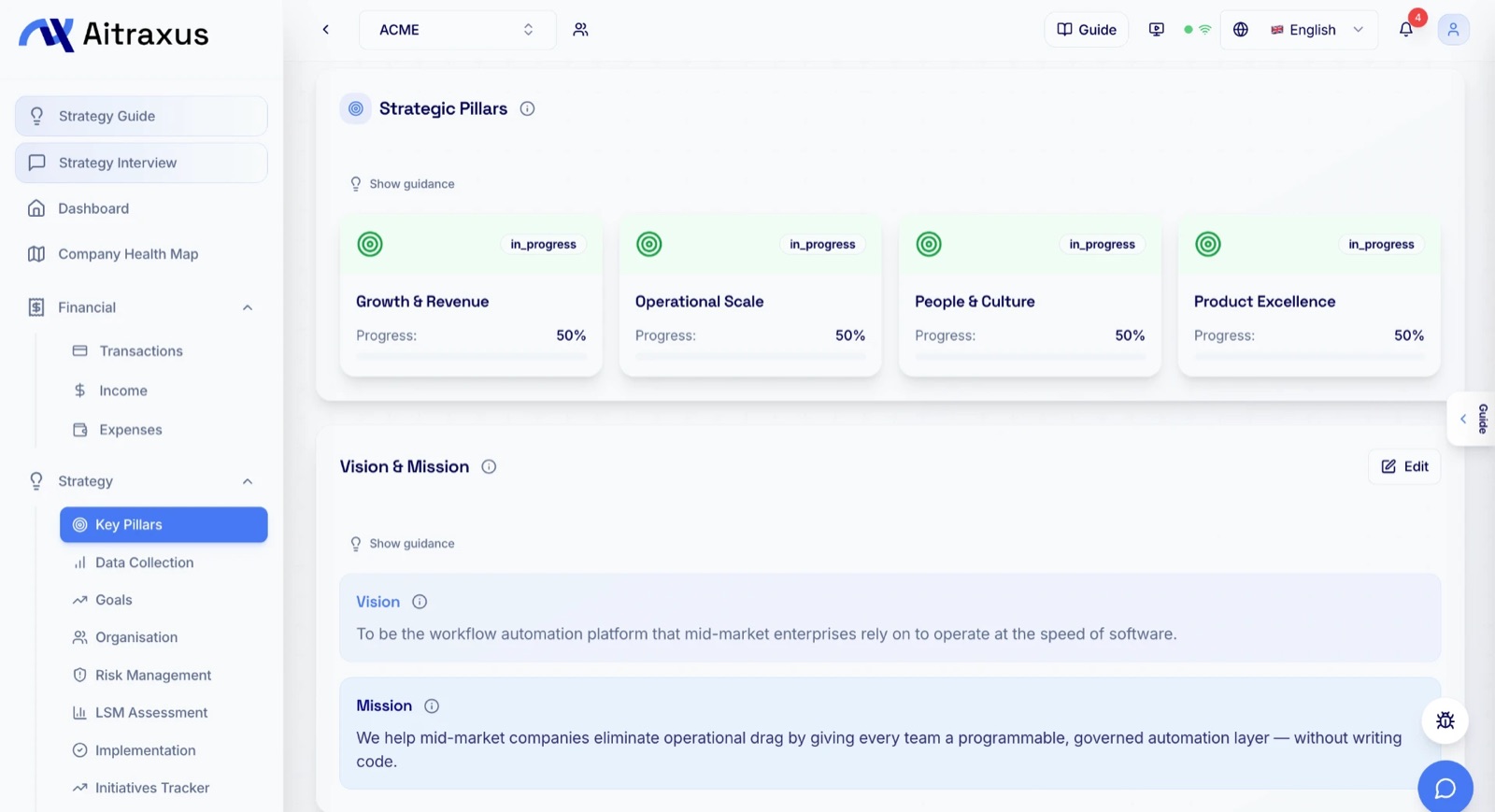
Aitraxus does not treat OKRs as a separate list. Objectives sit inside the strategy you build: strategic pillars at the top, goals under each pillar, and the initiatives that move them underneath.
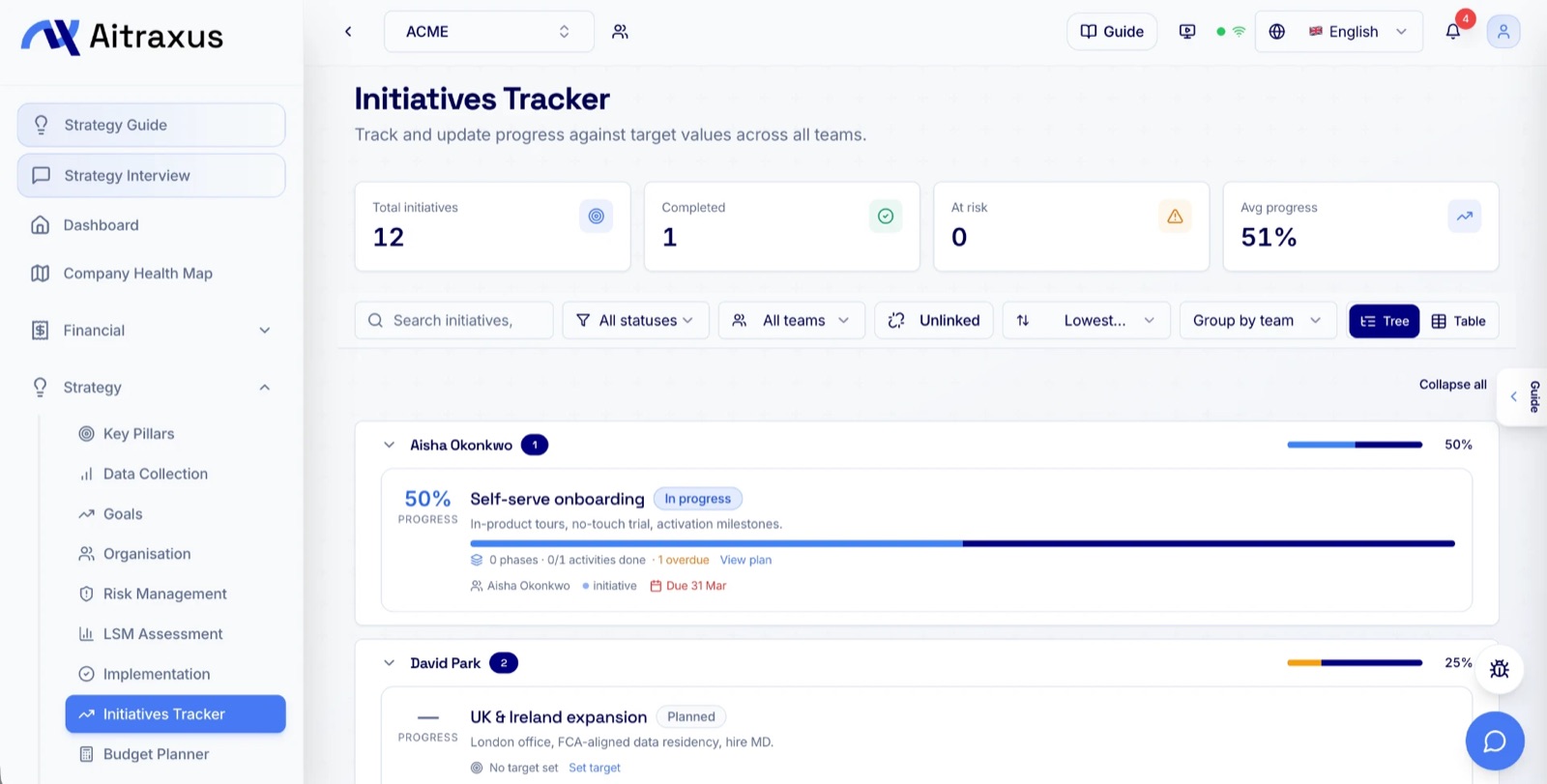
The Initiatives Tracker shows progress for each initiative, so the weekly check-in starts from current data rather than a status round.
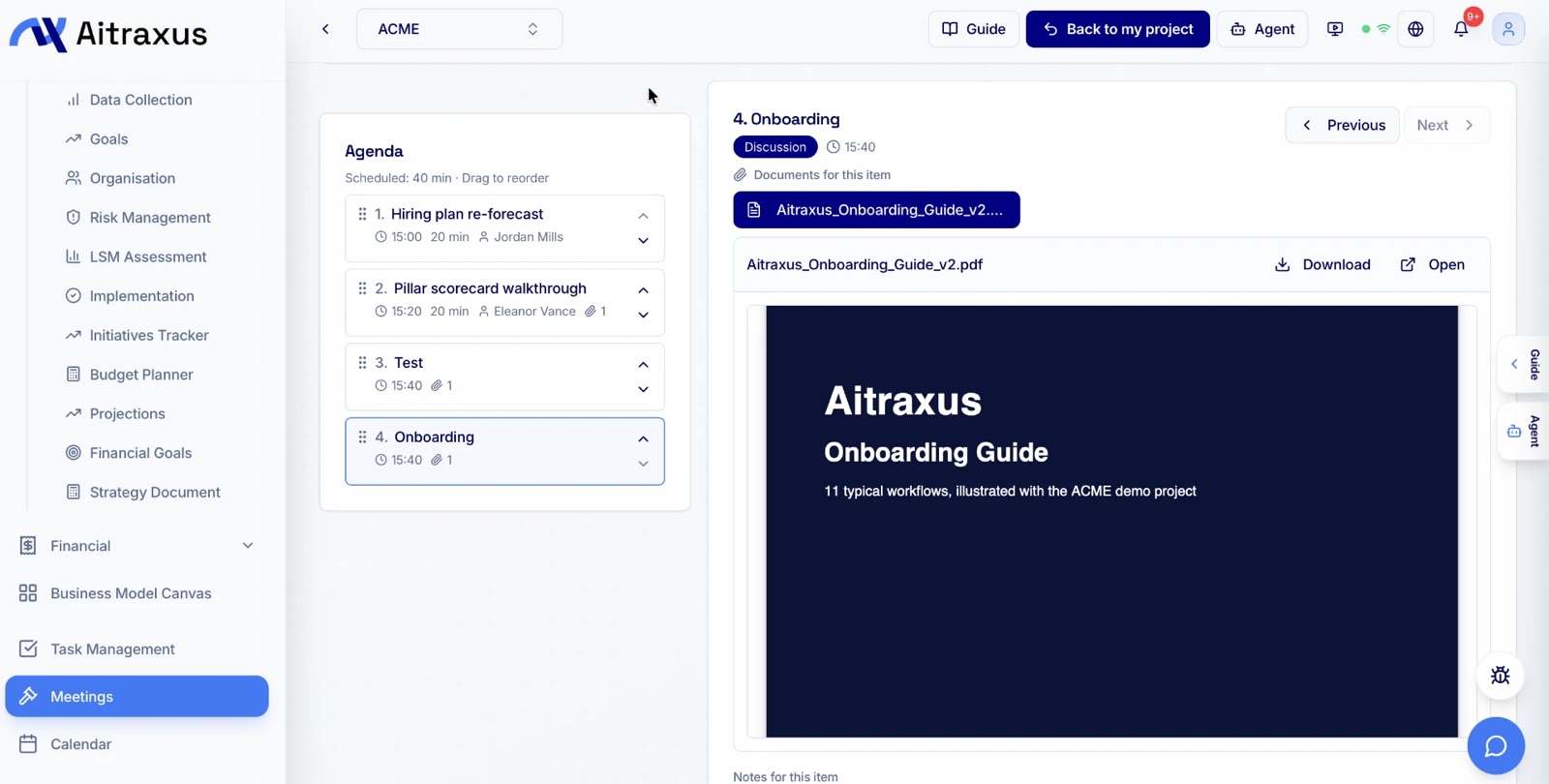
The Budget Planner links budget lines to initiatives, so you can see what each objective costs. Meetings record decisions and action items from the monthly and quarterly reviews, and board slides are generated from the same live data.
Sources
- What Matters, "What is an OKR? Definition and Examples"
- What Matters, "How to write OKRs with examples"
- What Matters, Measure What Matters by John Doerr, 2018
- Google re:Work, "Set goals with OKRs"
Frequently asked questions
How do you implement OKRs in a small company?
Start with a one-quarter pilot at company level: three to five objectives, two to four key results each, a weekly check-in and a quarterly scoring session. Add team OKRs only after the first cycle works.
What is the OKR process?
Set objectives and key results at the start of a cycle, usually a quarter. Check progress weekly, review in depth monthly, then score, learn and reset at the end of the quarter.
How many OKRs should a team have?
Google's re:Work guide recommends three to five objectives, and What Matters suggests three to five key results for each. Fewer is better when you are starting.
What is a good OKR score?
For aspirational OKRs, Google's guide expects an average of 0.6 to 0.7. Committed OKRs should be fully achieved. Mark which is which when you write them.
Should OKRs be linked to bonuses?
Google's guide says OKRs are not the same as performance evaluation. Linking scores to pay tends to make people set safe targets, which removes the point of the method.
What is the difference between OKRs and KPIs?
KPIs track the ongoing health of the business. OKRs pick the few things that must change this quarter. A KPI can become a key result when you want to move it, not just monitor it.
Try Aitraxus free and open the ACME demo project to see how objectives, initiatives and budgets connect to the strategy they serve.