Corporate, Business and Functional Level Strategy: The 3 Levels Explained
Corporate level strategy decides where you compete, business level strategy how you win. See all 3 levels of strategy with examples and frameworks.
There are three levels of strategy. Corporate level strategy decides which businesses or markets an organisation competes in. Business level strategy decides how each business wins against competitors. Functional level strategy decides how departments such as sales, operations, finance and people support that business strategy.
This guide explains each level with examples, compares corporate and business level strategy, shows the frameworks used at each level, and explains how the levels apply to a small or mid-sized company with a single business.
The three levels of strategy at a glance
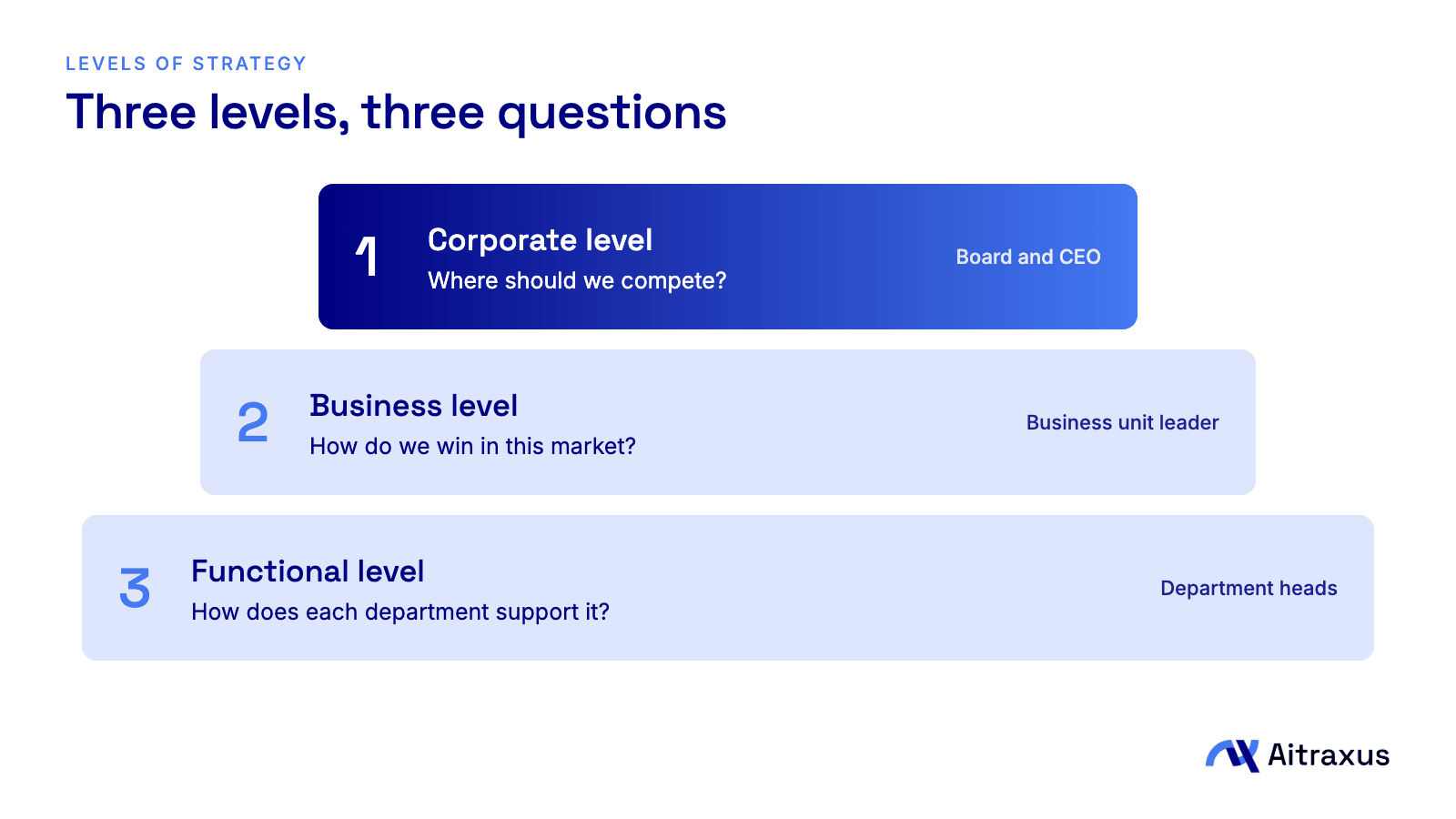
| Level | Question it answers | Typical owner | Time horizon | Common tools | Example |
|---|---|---|---|---|---|
| Corporate | Where should we compete? | Board and CEO | Several years | BCG matrix, Ansoff matrix | Enter a new market by acquisition |
| Business | How do we win in this market? | Business unit leader | One to several years | Porter's generic strategies, SWOT | Compete on differentiation |
| Functional | How does each department support it? | Department heads | Mostly annual | Budgets, OKRs, KPIs | A sales plan for a target segment |
Corporate level strategy
Corporate level strategy is about the scope of the whole organisation. The open textbook Principles of Management from OpenStax describes it as the choice to grow, maintain or shrink, with business units managed like a portfolio.
Typical corporate level decisions:
- Growth by entering new markets or launching new products.
- Diversification, which can be related, building on existing capabilities, or unrelated, moving into a different industry.
- Vertical integration, moving backward into a supplier's business or forward into a customer's.
- Acquisitions, partnerships and exits.
Examples:
- Amazon's acquisition of Whole Foods Market, which closed on 28 August 2017, moved Amazon into physical grocery retail. Amazon announced that Prime would become the Whole Foods rewards program and that the companies would integrate logistics and point of sale systems.
- Berkshire Hathaway owns businesses in very different industries, including GEICO, BNSF, Dairy Queen, Duracell and NetJets, a well-known example of unrelated diversification.
Corporate level frameworks
The BCG growth share matrix, which BCG dates to Bruce Henderson's 1970 essay "The Product Portfolio", sorts businesses by market growth and relative market share into stars, cash cows, question marks and pets. BCG's own history page notes that "all products will eventually become either cash cows or pets".
The Ansoff matrix, from Igor Ansoff's "Strategies for Diversification" in Harvard Business Review in 1957, sets out four growth paths: market penetration, market development, product development and diversification, the last being the riskiest.
Business level strategy
Business level strategy is about how one business competes in its market. OpenStax describes it as the framework a firm uses to organise its activities to compete, usually through cost leadership or differentiation.
Michael Porter's generic strategies, set out in his 1980 book Competitive Strategy, are the classic framework:
| Strategy | How you win | Example approach |
|---|---|---|
| Cost leadership | Lowest cost in the market | Standard products at scale, lean operations |
| Differentiation | Something customers value and pay more for | Better design, service or quality |
| Focus | Serve a narrow segment better than broad rivals | A niche of customers, on cost or on differentiation |
Porter warned that a business that tries to be everything risks being "stuck in the middle", without a clear advantage. Later researchers have found that some hybrid strategies can work, so treat this as a warning rather than a law.
Useful tools at this level include SWOT analysis, Porter's Five Forces and VRIO.
Functional level strategy
Functional level strategy turns the business strategy into plans for each department. If the business strategy is differentiation through service, the functional strategies might include a service training program, a customer success team, a pricing model that supports premium service and a hiring plan.
Typical functional strategies:
- Marketing and sales: target segments, channels and pricing.
- Operations: quality, capacity and cost.
- Finance: budgets, cash and investment rules.
- People: hiring, skills and incentives.
- Technology: systems and data that the strategy needs.
Functional strategies are where most execution happens, which is why they need owners, budgets and measures. Our guide to goals vs KPIs vs OKRs explains how to measure them.
Corporate vs business level strategy
| Corporate level | Business level | |
|---|---|---|
| Focus | Which businesses and markets | How to compete in one market |
| Scope | The whole organisation | One business unit or product line |
| Key decisions | Growth, diversification, acquisitions, exits | Positioning, pricing, value proposition |
| Frameworks | BCG matrix, Ansoff matrix | Porter's generic strategies, Five Forces |
| Main owner | Board and CEO | Business unit leader |
How the levels apply to a small business
This section is our own reasoning, applied to firms with a single business. In a small or mid-sized company with one business, corporate and business level strategy often merge into one set of choices: where to play, meaning which markets and whether to add a second product line, and how to win, meaning cost, differentiation or focus. Functional strategies then carry most of the work.
Worked example: a 40 person software company
This example is fictional, for illustration.
| Level | Decision |
|---|---|
| Corporate | Stay a single software business, and test training services as a related product extension |
| Business | Differentiation focus: the most usable reporting tool for NGOs in the region |
| Functional | A sales playbook for NGOs, a support team trained in donor reporting, a hiring plan and a cash runway of 18 months |
The three levels connect: the corporate choice limits where the company competes, the business choice decides how it wins, and the functional plans make it real.
Common mistakes
- Treating a collection of functional plans as the strategy.
- Being stuck in the middle, with no clear way of winning.
- Diversifying before the core business is secure.
- Using the BCG matrix when you have only one business.
- Assuming the levels do not apply to small companies.
- Functional plans that do not link back to the business strategy.
Connect all three levels in Aitraxus
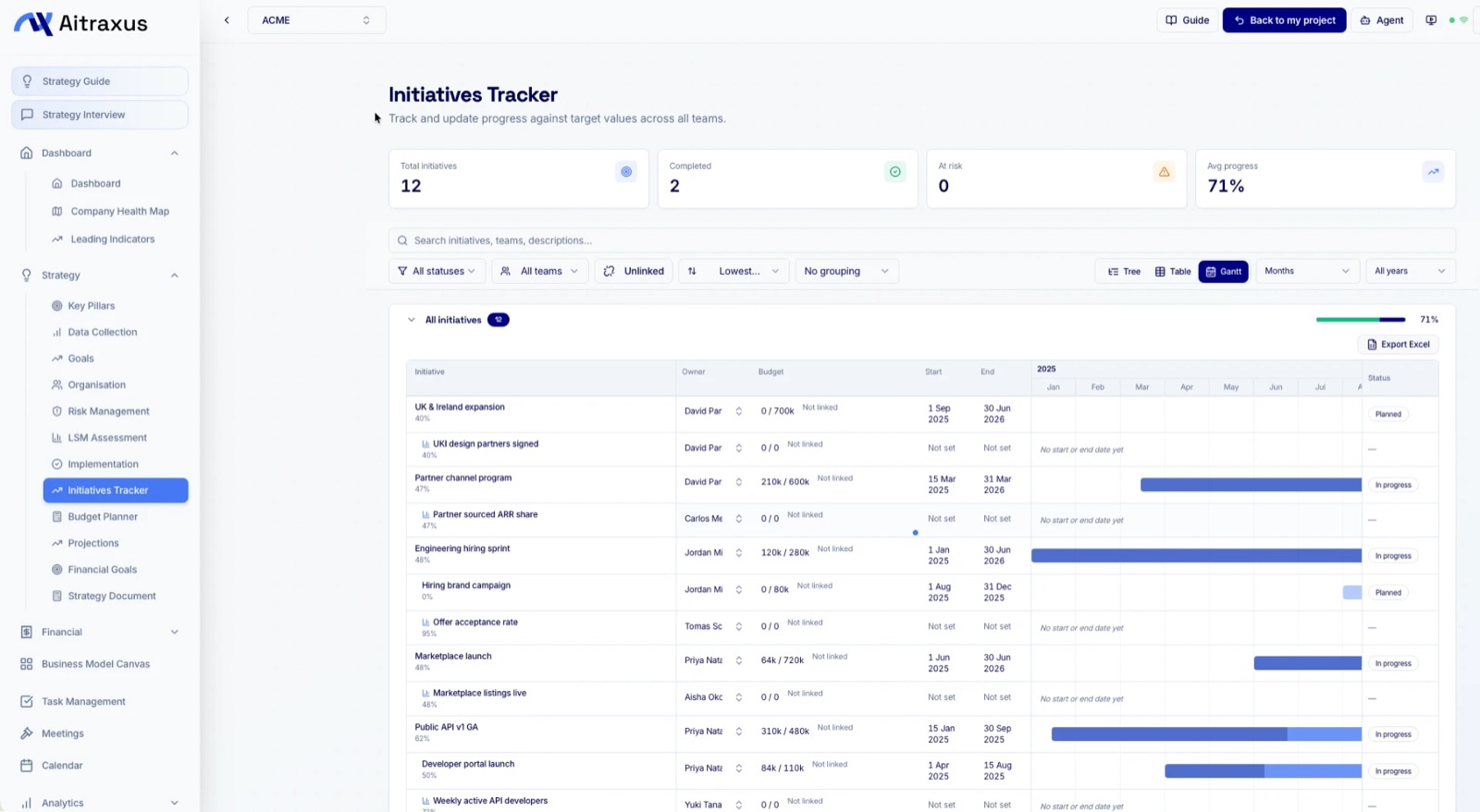
Aitraxus links the levels in one structure: strategic pillars capture the big choices, goals and initiatives express the business strategy, and initiatives with owners, budgets and timelines carry the functional plans. The Gantt view shows who delivers what and when, with progress and budget on each row.
For the full method, read our guide to the strategic planning process and how to choose strategic pillars.
Sources
- OpenStax, Principles of Management, 9.4 Strategic Objectives and Levels of Strategy
- BCG, The Growth Share Matrix
- Amazon and Whole Foods Market announce acquisition to close, 2017
- Berkshire Hathaway, subsidiary companies
- Strategic Management, Business LibreTexts, Selecting Corporate-Level Strategies
Frequently asked questions
What are the three levels of strategy?
Corporate level strategy decides where an organisation competes, business level strategy decides how each business wins, and functional level strategy decides how departments support it.
What is the difference between corporate and business level strategy?
Corporate level strategy covers the whole organisation and its choice of businesses and markets. Business level strategy covers how one business competes within its market.
What are examples of corporate level strategy?
Acquisitions, diversification into new industries, vertical integration and exiting a market. Amazon buying Whole Foods Market is a well-known example.
What is functional level strategy?
It is the plan each department follows to support the business strategy, such as the sales, operations, finance and people plans.
Is vertical integration a corporate level strategy?
Yes. Moving into a supplier's or a customer's business changes the scope of the organisation, which is a corporate level decision.
Do small businesses need a corporate level strategy?
Usually in a simpler form. A single-business company still decides where to play and whether to add new products or markets, even if that choice merges with its business strategy.
Try Aitraxus free and open the ACME demo project to see pillars, goals and initiatives connected.