Strategic Planning for Small Business: A Lean Process, One-Page Template and Example
Strategic planning for small business made practical: a lean process in four workshops, a one-page plan template, budget links and a worked example.
Strategic planning for a small business is deciding, as a leadership team, where the company should be in two to three years, which few priorities will get it there, and how scarce people and cash will be put behind them. It is the same discipline a large company uses, done with fewer people, less data and much less time, so it has to be lean and tied closely to the budget.
This guide is for owners and managers of companies with roughly 10 to 250 people and no strategy department. It covers how small business planning differs from a big company plan, a lean process that fits in four workshops, a one-page plan template, how to choose three priorities, how to link the plan to cash, a review rhythm, a worked example, common mistakes and a checklist.
What strategic planning means for a small business
For this guide, "small business" means what the European Commission calls an SME: fewer than 250 staff, with annual turnover up to €50 million or a balance sheet up to €43 million. Within that, a small enterprise has fewer than 50 staff and a micro enterprise fewer than 10. The Commission notes that 99% of European businesses are SMEs, so this is the normal case, not the exception.
The goal of planning is the same at any size. What changes is how you get there.
| Large company | Small or mid-sized business | |
|---|---|---|
| Who plans | A strategy or planning team, often with consultants | The owner and two to five managers, alongside their day jobs |
| Data | Market research, internal analysts, dashboards | Accounts, customer knowledge, sales history and what the team sees |
| Time available | Months, in a formal annual cycle | A few workshops spread over a few weeks |
| Number of priorities | Often many, cascaded through divisions | Three, sometimes fewer |
| Biggest constraint | Coordination across units | Cash and the time of a few key people |
| Document | Long plan with appendices | One page, plus a budget and a list of initiatives |
| Main risk | Plan disconnected from the front line | Plan crowded out by daily operations |
The last row matters most. In a small company the people who make the plan are the same people who answer customers, chase invoices and fix problems. A plan that needs a lot of upkeep will be dropped by March. Execution is hard even with more resources: in "Why Strategy Execution Unravels and What to Do About It" (HBR, 2015), Donald Sull, Rebecca Homkes and Charles Sull write that two thirds to three quarters of large organisations struggle with execution. So the process below is built to be short, and the review rhythm is built to be cheap.
A lean strategic planning process in four workshops
The full method is described in our guide to the strategic planning process. Here is the compressed version that suits a small leadership team. Each workshop is half a day to a day, with some preparation in between.
Workshop 1: Agree the facts
Before the meeting, one person gathers the last two or three years of revenue and margin by customer and product, the cash position, and a short list of what customers and staff say. In the workshop, look outward and inward:
- Outside: trends that affect you, using a quick PEST analysis, and the pressure from customers, suppliers and competitors, using Porter's Five Forces.
- Inside: what you are genuinely good at and where you are weak.
- Summary: a SWOT that leads to decisions, not a list of generic points.
Output: one page of findings the whole team agrees with.
Workshop 2: Set direction and choose three priorities
Write a short statement of where the company wants to be in two to three years, in plain words and with at least one number. Then list every candidate priority and cut the list to three, using the filters in the section below. Write down what you will stop or not start.
Output: a direction statement, three priorities and a stop list.
Workshop 3: Goals, initiatives and money
For each priority, set one or two goals with a measure, a target, a date and one owner. Then list the initiatives that will move each goal, estimate their cost in cash and in people's time, and check the total against what the business can afford.
Output: goals, initiatives with owners and dates, and a budget for each initiative.
Workshop 4: Review rhythm and launch
Agree the monthly and quarterly reviews, put them in the calendar for the whole year, and decide how you will explain the plan to staff. Many small companies skip this workshop. It is the one that decides whether the plan survives.
Output: a review calendar and a short launch message.
The one-page strategic plan template
A small business strategic plan should fit on one page. Detail lives in the budget and in the list of initiatives.
| Section | What to write | Example prompt |
|---|---|---|
| Where we are | Three to five facts from workshop 1 | What is true about our customers, margins and market today? |
| Where we want to be | Direction for the next two to three years, with a number | What will be different in three years, and how will we know? |
| Priority 1, 2, 3 | One line each | Where will we concentrate effort? |
| Goals | One or two per priority, with measure, target, date | What result proves the priority is working? |
| Initiatives | Two or three per priority, each with an owner | Which projects will move the goal? |
| Budget | Cost of each initiative and when the cash goes out | What does each initiative cost, and can we fund it? |
| Stop list | What we will stop or not start | What are we saying no to? |
| Review | Monthly and quarterly dates, who attends | When do we check, and who decides changes? |
How to choose three priorities with limited people and cash
Most small businesses can list ten good ideas. The work is choosing three. Run each candidate through these filters:
- Impact: does it move a number that matters for the direction, such as margin, recurring revenue or dependence on one customer?
- Capacity: who would lead it, and what would they stop doing? If the same two people would lead every priority, you have too many.
- Cash: can you fund it from operating cash flow, or does it need a loan or investor money you do not yet have?
- Speed of evidence: will you see a sign within three to six months that it is working? Small companies need early proof to keep going.
- Fit: does it build on something you are already good at? A VRIO check helps here.
A simple scoring table, one to five on each filter, makes the discussion concrete. Do not let the score decide on its own. Use it to find the debate.
The stop list is part of the choice. If nothing comes off the list of current activities, the new priorities will be squeezed into spare time that does not exist.
Linking the plan to the budget and cash flow
In a small business, strategy and cash flow are the same conversation. A plan with no cost attached is a wish list, and a budget with no link to the plan simply repeats last year.
Practical steps:
- Give every initiative a budget line, including staff time as a cost, not only external spend.
- Put the cash timing on a monthly view. An initiative that is affordable over the year can still cause a cash gap in the month the equipment or the new hire arrives.
- Stage larger initiatives. Release the second tranche only when the first shows results.
- Keep a small reserve that is not allocated to any initiative.
- Track actual spend against each initiative, not only against cost categories.
The U.S. Small Business Administration makes a related point in its guide to managing finances: "Looking closely at money-in and money-out helps maintain a sustainable balance between profit and loss." For the full method, see our guide to linking financial planning to strategic objectives.
A simple review rhythm
| Review | Length | Who | What to cover |
|---|---|---|---|
| Monthly | 60 to 90 minutes | Owner and priority owners | Progress on each initiative, spend against budget, blockers, one or two decisions |
| Quarterly | Half a day | Leadership team, board or advisor if you have one | Are the goals moving? Is any priority wrong? What should change for the next quarter? |
| Annual | One to two days | Leadership team | Refresh the facts, confirm or change the three priorities, set the next budget |
Keep the monthly meeting short and about decisions, not status reports read aloud. Our guide to quarterly strategy reviews gives an agenda you can copy.
Worked example: a 25 person metal fabrication company
This example is fictional, for illustration.
A family-owned metal fabrication company with 25 staff makes custom parts for local machinery builders. The owner and three managers run the planning over four half-day workshops in January.
| Plan element | What they decided |
|---|---|
| Where we are | 55% of revenue comes from three customers. Margins on rush jobs are good, margins on large repeat orders are thin. Two experienced welders retire within three years. |
| Where we want to be | By the end of year three, no customer above 15% of revenue and gross margin up from 22% to 28%. |
| Priority 1 | Win new customers in two adjacent sectors |
| Priority 2 | Price and quote by margin, not by habit |
| Priority 3 | Secure skills through training and one apprentice per year |
| Goals | Six new active customers by year end. Average quoted margin tracked on every quote within six months. One apprentice hired by September. |
| Initiatives | A sales manager role split with the owner, a quoting spreadsheet with margin targets, a partnership with the local vocational school |
| Budget | Most of the cost is people time. The external spend is a trade fair and apprentice wages, both phased into the second half of the year to protect cash. |
| Stop list | No new bespoke one-off products for existing customers below the target margin |
| Review | First Monday of each month, 75 minutes. Quarterly half day with the company's accountant present. |
The plan was one page. The first quarterly review showed that new customer meetings were happening but quotes were too slow, so the team moved the quoting initiative ahead of the trade fair. That kind of correction is what the review rhythm is for.
Common mistakes
- Copying a large company template, then abandoning it because nobody has time to maintain it.
- Choosing five or more priorities with the same two people leading all of them.
- No stop list, so new work is added on top of everything else.
- Planning without the numbers: no cost per initiative and no monthly cash view.
- Goals without one named owner.
- Holding the planning workshops, then never meeting again until next January.
- Keeping the plan in the owner's head, so staff cannot connect their work to it.
Small business strategic planning checklist
- We agreed the facts before discussing ambitions.
- Our direction for the next two to three years includes at least one number.
- We chose three priorities and wrote down what we will stop.
- Every goal has a measure, a target, a date and one owner.
- Every initiative has a cost, a cash timing and an owner.
- The plan fits on one page.
- Monthly and quarterly reviews are in the calendar for the whole year.
- Staff have heard the plan explained in plain words.
Build your small business strategic plan in Aitraxus
Aitraxus is built for teams without a strategy department. The Aitraxus solution for SMEs brings the steps above into one place.
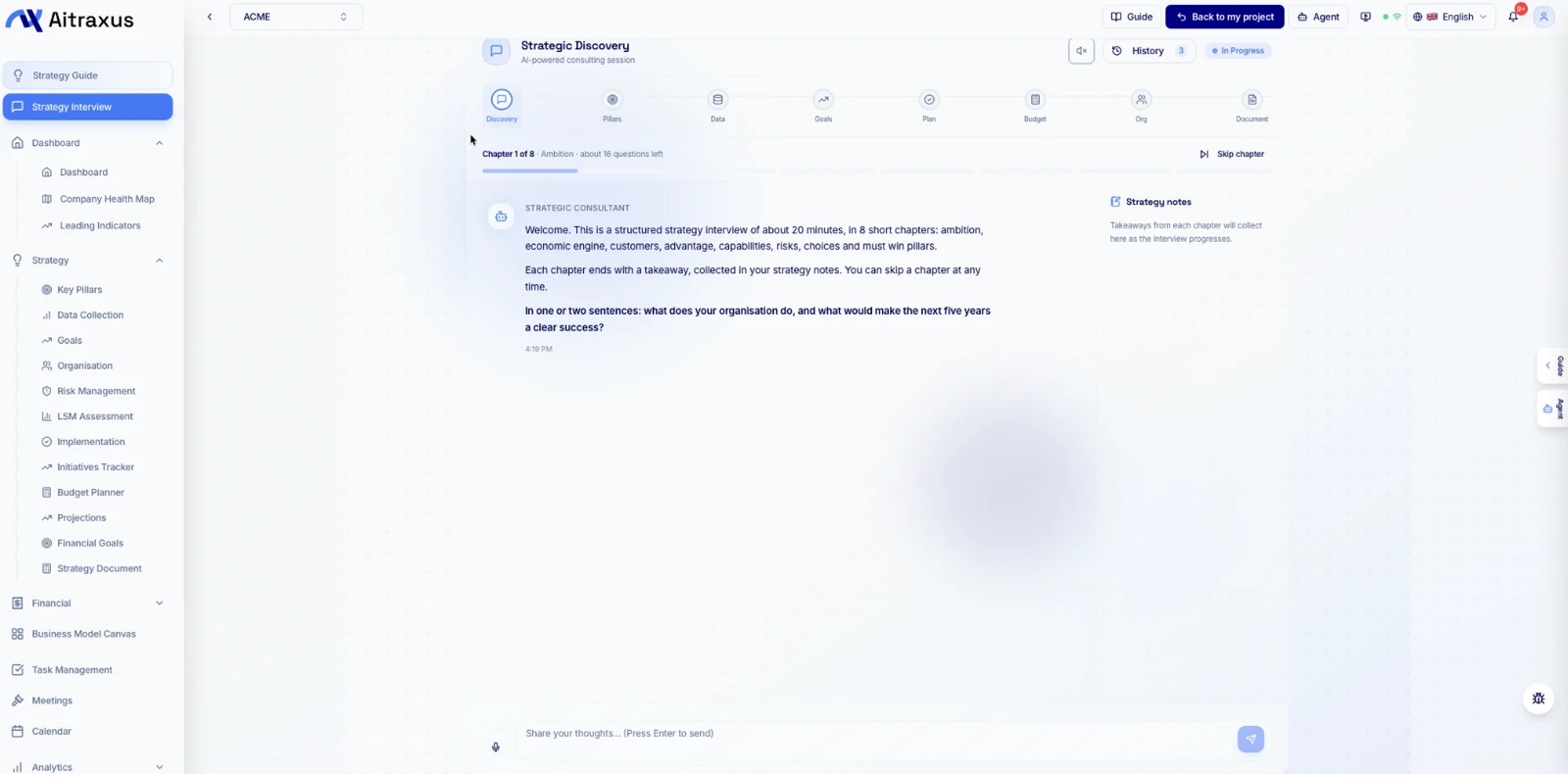
Start with the AI discovery interview. It asks your leadership team the questions a facilitator would ask about your business, customers and ambitions, and turns the answers into a starting point for your strategy. Our article on AI strategy discovery interviews explains how it works.
From there, the Strategy Guide takes you through pillars, data collection with PEST, Five Forces, SWOT or VRIO, goals and initiatives. The Budget Planner links costs to each initiative, so the plan and the money stay connected.
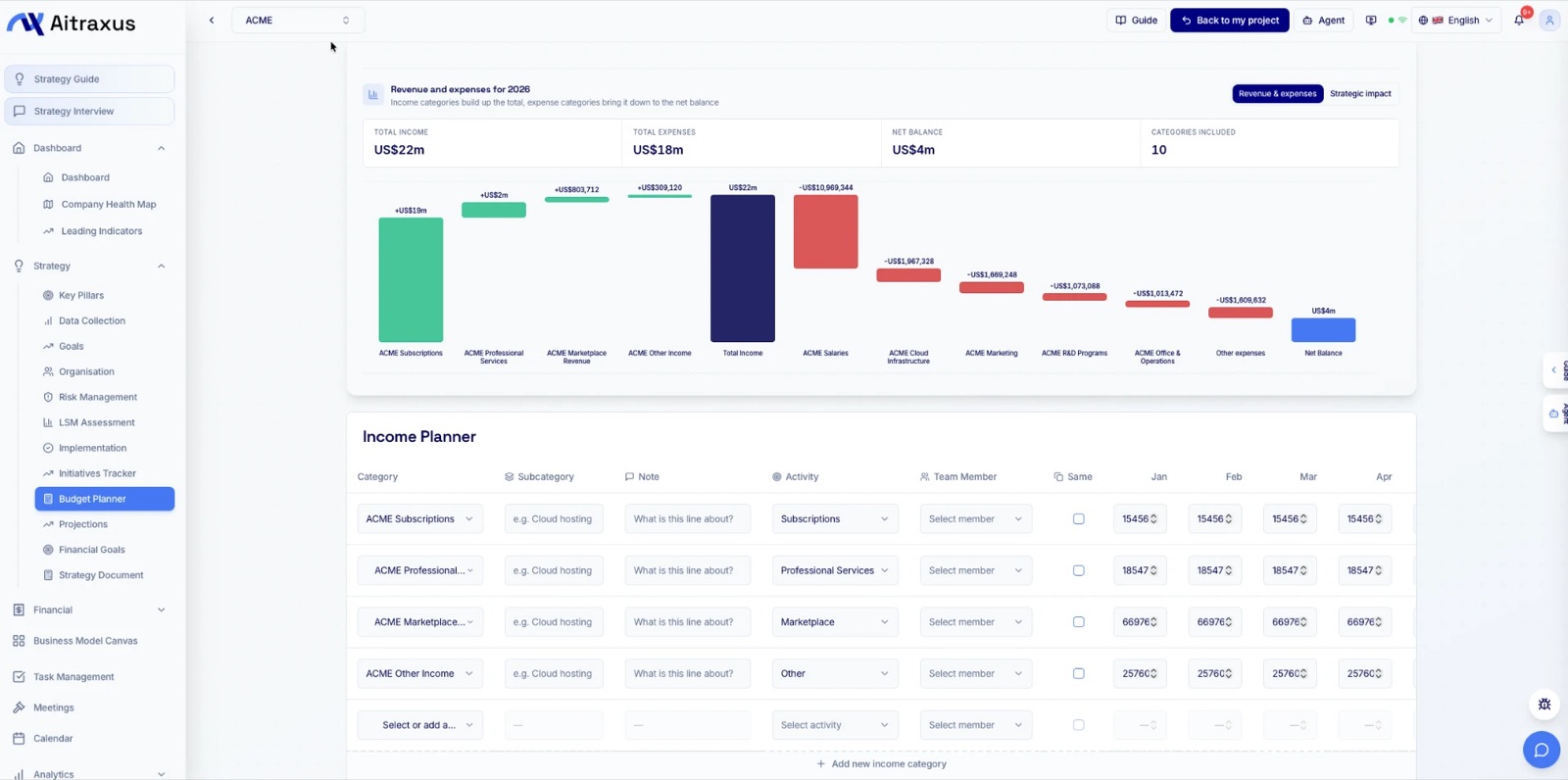
You can explore all of this in the free ACME demo project, a complete example strategy, before you build your own.
Sources
- European Commission, SME definition (Recommendation 2003/361)
- European Commission, Internal Market, Industry, Entrepreneurship and SMEs: SMEs
- U.S. Small Business Administration, Write your business plan
- U.S. Small Business Administration, Manage your finances
- Sull, Homkes and Sull, "Why Strategy Execution Unravels and What to Do About It", HBR, 2015
Frequently asked questions
What is strategic planning for a small business?
It is the process of deciding where the business should be in two to three years, choosing a few priorities to get there, and putting people and cash behind them, with a regular review to keep the plan current.
How is a small business strategic plan different from a business plan?
A business plan usually describes the business as a whole, often for a lender or investor. The U.S. Small Business Administration describes a lean format that fits on one page and a traditional format that can run to dozens of pages. A strategic plan focuses on direction, priorities and how you will get there, and is mainly for the leadership team and staff.
How long should a small business strategic plan be?
One page for the plan itself, supported by a budget and a list of initiatives with owners and dates. If it takes longer to read than a short meeting, it will probably not be used.
How many strategic priorities should an SME have?
Three is a practical number for most small and mid-sized businesses. More than that usually means the same few people lead everything and nothing gets enough attention.
How often should a small business review its strategic plan?
Check progress monthly, review the strategy itself each quarter, and refresh the facts and priorities once a year, or sooner if a major customer, market or cost changes.
What are good strategies for a small business?
There is no single list. Common choices are focusing on a niche, reducing dependence on a few customers, improving pricing and margins, building recurring revenue, and securing key skills. The right ones come from your own facts, not from a generic list.
Try Aitraxus free and open the ACME demo project to see a complete small business strategy, from interview to budget and review.