Business Model Canvas: The Nine Blocks, How to Fill It In and Use It as a Strategy Diagnostic
The Business Model Canvas explained: the nine building blocks, the order to fill them, how to use it as a strategy diagnostic, an SME example and Lean Canvas.
The Business Model Canvas is a one-page template that describes how an organisation creates, delivers and captures value, using nine building blocks: customer segments, value propositions, channels, customer relationships, revenue streams, key resources, key activities, key partnerships and cost structure. It was developed by Alexander Osterwalder and Yves Pigneur and popularised by their 2010 book Business Model Generation. Strategyzer, the company behind it, publishes the official template.
This guide explains each block with a guiding question, the order to fill it in, how to use the canvas as a strategy diagnostic for an existing business, a worked SME example, how it compares with the Lean Canvas, common mistakes and a checklist.
What is the Business Model Canvas?
Strategyzer describes a business model as "the rationale of how an organization creates, delivers, and captures value." The canvas breaks that rationale into nine blocks on one page, so a team can see the whole model at once and discuss how the parts fit.
The layout has a logic. The right side covers the market: who you serve, what you offer them, how you reach them and how they pay. The left side covers what you need to deliver that: resources, activities and partners. The bottom row holds the money: costs on the left, revenue on the right.
The book Business Model Generation, by Osterwalder and Pigneur, was published by Wiley in 2010. Its publisher notes it was co-created by 470 practitioners from 45 countries.
The nine building blocks
The guiding questions below follow the wording Strategyzer uses in its book summary, with notes on what a useful answer looks like.
| Block | Guiding question | A useful answer names |
|---|---|---|
| Customer segments | Who are your most important customers? | Specific groups, ranked by the revenue and margin they bring, not demographics alone |
| Value propositions | What value do you deliver to customers? | The job or problem you solve for each segment, in their words |
| Channels | How do you reach your customers? | How customers actually find, buy and receive the offer, which may differ from the official story |
| Customer relationships | What type of relationship do you establish with customers? | Self-service, dedicated account manager, community, subscription, and so on |
| Revenue streams | How does your business earn money? | Pricing model, payment timing and share of revenue per stream |
| Key resources | What assets are indispensable to your business? | People, data, equipment, brand, licences; mark which are hard to copy |
| Key activities | What activities must you excel at? | The few things that create the value, and that your calendar actually reflects |
| Key partnerships | Who are your key partners and suppliers? | Partners and what each relies on you for; flag single points of dependency |
| Cost structure | What are your most important costs? | Fixed and variable costs, and which segments or offers drive them |
How to fill in the Business Model Canvas
A practical order starts with the customer and ends with costs. It keeps the discussion anchored in demand rather than in what the company happens to own.
1. Customer segments
Start with who actually generates most of your revenue today. Segment by value and need, not just company size or age group. If two segments need different things, they belong in separate rows.
2. Value propositions
For each segment, write the specific problem you solve. "We save customers time" is too broad. "We get urgent print jobs to retail stores within 24 hours" is something a customer would recognise.
3. Channels and 4. customer relationships
Describe how each segment finds you, buys from you and gets support. Ask Sales and customer service, not only Marketing. Then note the type of relationship and what it costs to maintain.
5. Revenue streams
List how each segment pays: one-off, subscription, usage, retainer. Add the rough share of total revenue and, if you know it, the margin.
6. Key resources, 7. key activities and 8. key partnerships
Now ask what the right side requires. Which resources, activities and partners make the value propositions possible? Mark anything that competitors cannot easily copy; the VRIO framework is useful here.
9. Cost structure
Finish with the main costs, and link each one to the blocks that cause it. This is where the canvas meets your budget.
Use real data where you have it, sticky notes or a shared document, and a cross-functional group of five to seven people. Disagreements during the session are useful: they show where the leadership team holds different views of the business.
Using the canvas as a strategy diagnostic
The canvas is often taught as a startup design tool. For an established business it is at least as useful as a diagnostic, a way to find where the model no longer fits together. Strategyzer publishes an assessment tool for leaders that scores a business model on nine questions, one per building block, and notes that "No business model achieves a perfect score."
Find the weak blocks
Score each block from 1 to 5 on two things: how strong it is compared with alternatives customers have, and how confident you are in the evidence behind it. Low scores on either point to blocks that need work or testing.
Check the fit between blocks
Most problems sit between blocks, not inside one. Look for:
- A segment that the cost structure cannot serve profitably.
- A value proposition that the key activities do not support.
- Channels that suited customers five years ago but not today.
- A key partnership that is a single point of failure.
Map current state against target state
Fill in a current-state canvas from evidence. Then draw a target-state canvas for the business you want to be in three years. The differences between the two are the gaps your strategy must close.
Spot strategic drift
Drift happens when a business adds activities, teams and costs one decision at a time while the value proposition and pricing stay the same. On the canvas it often shows as a left side (activities, resources, costs) that has grown away from the right side (segments, value, revenue).
Test your assumptions
Mark every item as evidence or assumption. For the riskiest assumptions, such as "segment B will pay for the premium tier", agree a cheap test: a pilot, customer interviews or a price test, with a date to decide.
Link the canvas to SWOT and pillars
The canvas does not show competitors, market trends or choices between options. Pair it with other tools:
- Weak blocks and fragile dependencies become weaknesses in your SWOT analysis; hard-to-copy resources become strengths.
- Market forces from Porter's Five Forces explain pressure on revenue streams and channels.
- The three to five gaps between current and target state often map onto your strategic pillars.
- Cost structure changes belong in a budget linked to strategic objectives.
Business Model Canvas example for an SME
This example is fictional, for illustration.
Brightline Print is a 35 person print and packaging company. Ten years ago it served local small businesses with short-run printing. Today it also supplies branded packaging to three regional retail chains.
| Block | Current state |
|---|---|
| Customer segments | Local small businesses (45% of revenue), three retail chains (40%), events and agencies (15%) |
| Value propositions | Fast short runs and friendly service for small businesses; reliable packaging supply for retailers |
| Channels | Walk-in shop and phone for small businesses; account manager for retailers |
| Customer relationships | Personal and informal for small businesses; contract with quarterly reviews for retailers |
| Revenue streams | Per-job pricing for small businesses; annual supply contracts for retailers |
| Key resources | Digital print presses, one packaging line, two experienced prepress staff |
| Key activities | Prepress, printing, packaging production, delivery |
| Key partnerships | Paper supplier (one main supplier), courier firm |
| Cost structure | Staff (largest cost), paper, machine leases, delivery |
The diagnostic found three issues:
- Drift: retail packaging now drives most of the planning effort and machine time, but pricing and service are still set up for small walk-in jobs.
- Dependency: one paper supplier and two prepress staff are single points of failure.
- Fit: small businesses want online ordering, which the current channels do not offer.
The target-state canvas focused on retail packaging as the main segment, with an online ordering channel for small businesses. The gaps became three priorities for the strategic plan: price and contract model for retail, a second paper supplier and cross-trained prepress staff, and a simple online ordering service.
Business Model Canvas vs Lean Canvas
The Lean Canvas was created by Ash Maurya as an adaptation of the Business Model Canvas. In his own explanation, he removed key activities, key resources, customer relationships and key partners, and added problem, solution, key metrics and unfair advantage. He writes that Lean Canvas "was designed for entrepreneurs".
| Business Model Canvas | Lean Canvas | |
|---|---|---|
| Created by | Osterwalder and Pigneur | Ash Maurya |
| Main use | Describing, designing and diagnosing a business model | Testing a new venture idea |
| Unique blocks | Key partners, key activities, key resources, customer relationships | Problem, solution, key metrics, unfair advantage |
| Shared blocks | Customer segments, value propositions, channels, revenue streams, cost structure | The same five, with "unique value proposition" |
| Best for | Existing businesses, strategy reviews, new business units | Early-stage startups and new products |
For an SME with an existing business, the Business Model Canvas is usually the better fit because it shows the resources, activities and partners you already depend on.
Common mistakes
- Filling in the canvas the leadership team believes in, not the one the evidence shows.
- Listing demographics instead of customer needs.
- One generic value proposition for all segments.
- Mixing two different business models on one canvas without separating them.
- Treating the canvas as finished once it is filled in, with no diagnostic step.
- Not linking the cost structure to the budget.
- Ignoring competitors and market trends, which the canvas does not show on its own.
Business Model Canvas checklist
- All nine blocks are filled in from evidence, with assumptions marked.
- Segments are ranked by revenue and margin.
- Each segment has its own value proposition.
- Every cost is linked to the blocks that cause it.
- Fit between blocks has been checked and weak blocks scored.
- A target-state canvas exists, with three to five gaps named.
- The gaps feed into SWOT, pillars and the budget.
The Business Model Canvas in Aitraxus
Aitraxus includes a Business Model Canvas module with all nine blocks, which you can populate with a first draft from your AI discovery interview and then edit with your team.
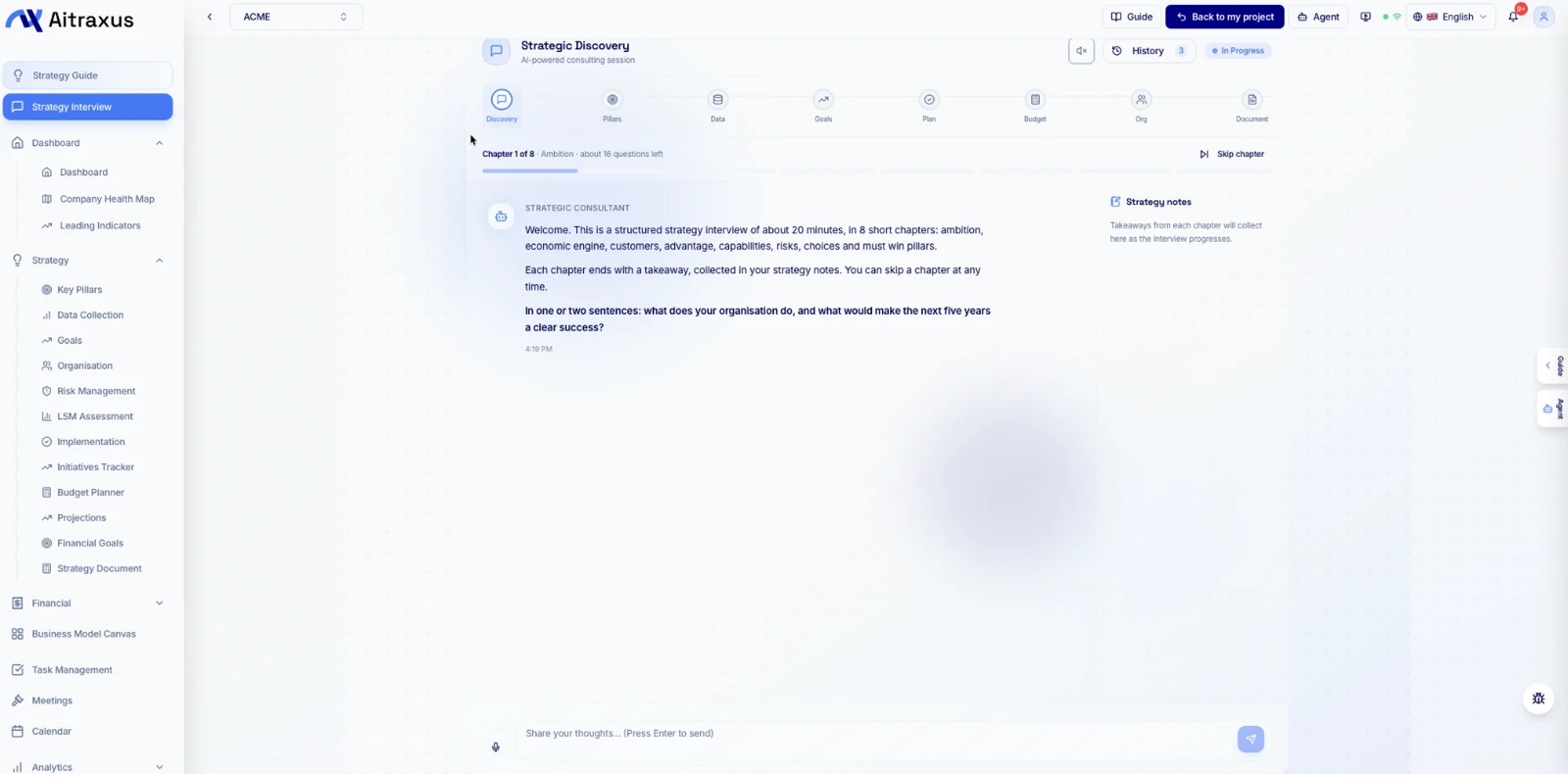
The canvas sits next to the rest of your strategy work: SWOT, PEST, Five Forces and VRIO in Data Collection, then pillars, goals, initiatives and a linked budget. For more on how these tools fit together, see strategic frameworks compared, or read about Aitraxus for small and mid-sized businesses.
Sources
- Strategyzer, The Business Model Canvas
- Strategyzer, Business Model Generation book summary
- Strategyzer, What is a business model?
- Strategyzer, Assessment Questions for Leaders
- Wiley, Osterwalder and Pigneur, Business Model Generation, 2010
- Ash Maurya, "Why Lean Canvas versus Business Model Canvas", 2024
Frequently asked questions
What are the nine building blocks of the Business Model Canvas?
Customer segments, value propositions, channels, customer relationships, revenue streams, key resources, key activities, key partnerships and cost structure.
How do you fill in a Business Model Canvas?
Start with customer segments and value propositions, then channels, customer relationships and revenue streams. Next add the key resources, activities and partners needed to deliver them, and finish with the cost structure. Use evidence and mark assumptions.
Who created the Business Model Canvas?
Alexander Osterwalder and Yves Pigneur. It became widely known through their 2010 book Business Model Generation, and Strategyzer publishes the official template.
What is a good Business Model Canvas example?
A good example uses specific, evidence-based entries and shows how the blocks connect, such as the fictional Brightline Print example above, where the canvas revealed drift between retail packaging and a pricing model built for walk-in jobs.
What is the difference between the Business Model Canvas and the Lean Canvas?
The Lean Canvas, by Ash Maurya, swaps key partners, activities, resources and customer relationships for problem, solution, key metrics and unfair advantage. It suits early-stage startups; the Business Model Canvas suits existing businesses better.
Can the Business Model Canvas be used for strategy?
Yes. Used as a diagnostic, it shows weak blocks, poor fit between blocks and drift between current and target state. Those gaps become inputs to SWOT, strategic priorities and the budget.
Try Aitraxus free and open the ACME demo project to see how the discovery interview, SWOT, pillars and initiatives connect, then map your own business on the canvas.